The transition from Class 12 to higher education is, for most Indian students, shaped by a narrow and familiar set of expectations. Engineering, management and law are commonly presented as the responsible choices, while creative inclinations are treated as hobbies or deferred to some later date. Against this background, the Finance Minister’s decision to speak in Parliament of creativity as a serious source of national employment prompted a reasonable question among students: Does this signal that the creative field is finally being taken seriously, or is it simply another headline?
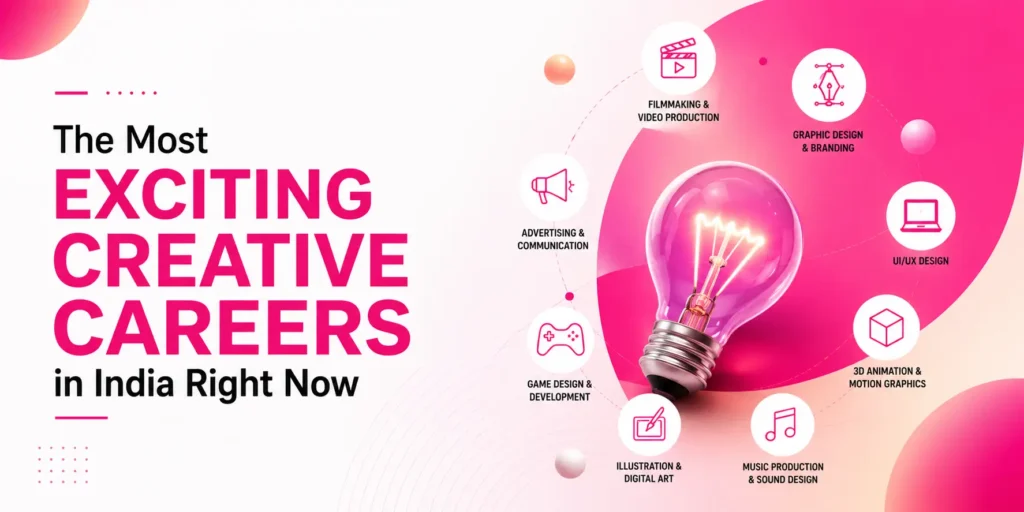
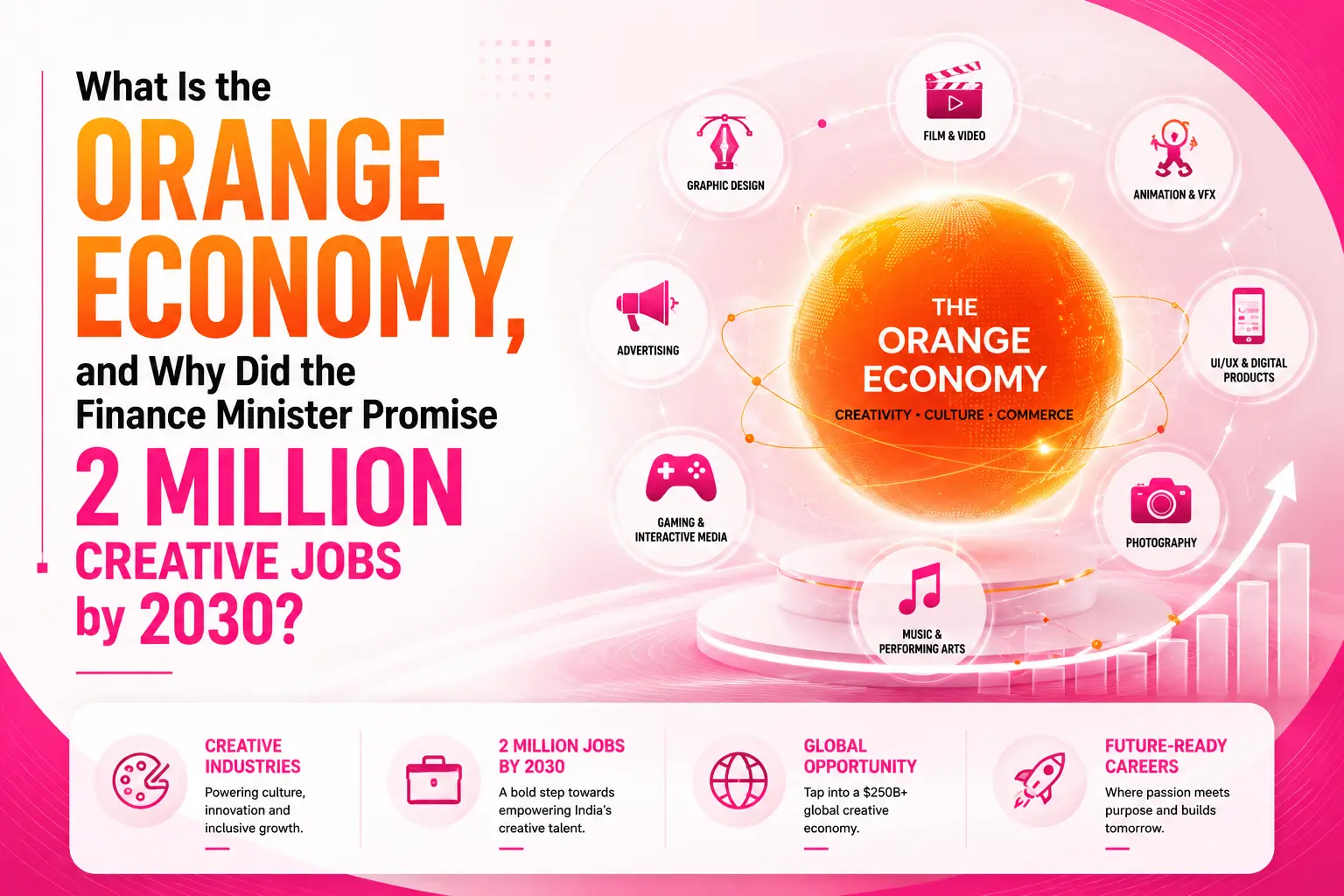
The evidence suggests that a meaningful change has taken place, one that deserves to be understood before a course is selected. At its centre lies the Orange Economy, also known as the creative economy, the segment of economic activity that derives value from imagination, culture and intellectual property rather than from tangible goods. It spans advertising, design, media, film, music, gaming, animation, digital content and creative technology, and India is now advancing it as a substantial engine of employment.
What exactly is the Orange Economy?
The term Orange Economy was popularised by former Colombian President Ivan Duque Marquez and Felipe Buitrago in their 2013 book, “The Orange Economy: An Infinite Opportunity.” They chose orange because the colour has long been linked with culture, creativity and identity.
The idea behind it is simple. In a traditional economy, value comes from a physical product: a car, a phone, a bag of cement. In the Orange Economy, value comes from an idea that is protected and sold as intellectual property. A film script, a brand campaign, a mobile game, a piece of animation, a song, a typeface, a logo system: each of these begins as imagination and ends as something with real commercial worth. The raw material is human creativity, and unlike coal or steel, it does not run out.
For a country with a young population, high digital adoption and a deep cultural back catalogue, this is not a small opportunity. It is arguably one of the few sectors where India has both the talent and the market at the same time.
What did the Finance Minister actually say in Parliament?
Here is the part worth quoting accurately, because a lot of social media posts blurred the numbers.
In the Union Budget 2026-27, presented in Parliament on 1 February 2026, Finance Minister Nirmala Sitharaman described India’s Animation, Visual Effects, Gaming and Comics sector, commonly shortened to AVGC, as a growing industry that is projected to require around 2 million professionals by 2030. To help build that workforce, she proposed support for the Indian Institute of Creative Technologies (IICT) in Mumbai to set up AVGC Content Creator Labs in 15,000 secondary schools and 500 colleges across the country.
Two points matter for honesty. First, the figure of 2 million professionals by 2030 is the projected requirement of the AVGC segment specifically, not a guarantee of jobs handed out. Second, the wider “20 lakh new jobs” framing that appeared in the news was the estimate offered by the Information and Broadcasting Minister, Ashwini Vaishnaw, while explaining the scale of the Orange Economy push. So the ambition is real, and it is backed by official policy, but it is a demand projection and a skilling plan, not a placement promise. That distinction is exactly the kind of thing a careful student should notice.
The signal, though, is clear. When the Union Budget names the creative economy, funds a national institute for it, and sets a workforce target, the field is no longer sitting at the margins.
Why did traditional courses become the default choice in India?
None of this means Engineering, BBA or Law were bad choices. For a couple of generations, they were genuinely the most rational bets. They came with a clear syllabus, a recognisable degree, a visible salary ladder and, most importantly, social approval. A parent could explain “my child is doing engineering” to any neighbour and be understood instantly.
Creative work did not offer that comfort. It looked unstructured, the income seemed unpredictable, and there was no obvious entrance exam to anchor the decision. So families defaulted to what felt measurable. That was a sensible response to the information available at the time.
The problem is that the information has changed, and a lot of career advice has not caught up.
Why is the career market changing now?
A number of changes took effect simultaneously. For instance, every business has become, to some degree, a content business, irrespective of whether it sells cars, coaching classes or credit cards; brands now compete on the effectiveness of their communication as much as on what they produce. Digital platforms have rendered design, video and storytelling everyday commercial necessities rather than intermittent luxuries. Meanwhile, artificial intelligence has begun to undertake the repetitive components of many occupations.
This last observation merits careful interpretation, for its implications run in two directions. Artificial intelligence can generate a preliminary layout, a first draft or a simple edit almost instantly. What it cannot accomplish independently is to decide what a brand ought to stand for, to judge whether an idea is fresh or stale, or to understand why a given story will connect with a given audience. Such decisions are inherently creative. Accordingly, the most resilient creative careers are moving towards original thought, strategy and taste, while the routine tier of production is automated. The student who cultivates judgment, and not merely technical skill, is constructing something of lasting value.
Traditional courses versus new-age creative programmes: how do they really compare?
This is usually where the confusion peaks, so it helps to put the two paths side by side, honestly. Neither column is “better.” They simply reward different kinds of people.
| Dimension | Engineering / BBA / Law | Brand Communication / Communication Design / Visual Communication |
| Core focus | Technical, managerial or legal systems and rules | Ideas, communication, design and audience behaviour |
| How you are assessed | Mostly exams, theory papers and marks | Mostly projects, portfolios and real briefs |
| What proves your ability | Your degree and scores | Your body of work and how you think |
| Typical entry route | Entrance exams such as JEE, CAT or CLAT | Aptitude, a creative interview and often a portfolio |
| Where demand is heading | Stable, established, competitive | Expanding across advertising, digital, media and design |
| Best suited to | Structured, rule-driven, analytical minds | Visual, verbal, curious and idea-driven minds |
The single biggest difference is the last row. Traditional courses reward students who are comfortable with fixed answers. Creative programmes reward students who are comfortable making something from a blank page and defending why it works.
What skills do you actually build in a creative programme?
A good creative course is not “learn to draw” or “learn to post reels.” It teaches a working professional’s toolkit. At NoMAD College, for example, the curriculum spans areas such as typography, branding and brand strategy, storytelling, consumer psychology, digital design, UX, motion graphics, media planning, content, digital campaigns and AI-integrated creative workflows.
Read that list again as an employer would. It is a mix of thinking skills and making skills. You learn how to understand a consumer, shape a message, design how it looks, and plan where it runs. That combination is precisely what agencies, brands and media companies are short of, and it is the kind of work that does not vanish when the next software update arrives.
Read More: Why a Creative Diploma Course Is India’s Smartest Career Bet in the Orange Economy
What careers open up after Brand Communication, Advertising, Design or Media?
More than most students expect. A single creative foundation can lead to roles such as brand strategist, art director, graphic designer, creative director, content creator, communication specialist, media planner, advertising executive and digital marketer. Some of these live inside advertising agencies. Others sit inside brands, media houses, production studios, startups or, increasingly, a student’s own independent practice.
Cities matter here, too. Mumbai and Bangalore are among India’s strongest hubs for advertising, media and design, which means proximity to live projects, mentors and internships is a real advantage, not a footnote.
Do creative careers offer stability and standing?
A creative career is neither a matter of chance nor an easy alternative. As with law or management, the outcome depends substantially on skill, discipline and the quality of work a student is able to demonstrate. The distinction is that, in creative fields, proof of ability rests in the portfolio rather than in the certificate alone. A student who can show a strong portfolio, genuine internship experience and clear thinking is not taking a reckless risk. Such a student is entering a sector that the Union Budget itself has now identified as a significant future employer.
Respectability, for its part, is advancing quickly. When national policy, international summits and major brands all regard creative work as serious economic activity, the longstanding notion that art cannot constitute a career begins to appear outdated.
Where does NoMAD College fit into this?
If a student decides that the creative path suits them, the next question is where to study it in a way that leads to actual work rather than only theory.
NoMAD College of Creative Intelligence, associated with Miami Ad School India, is built around a portfolio-first idea: you learn by doing real creative work, not by memorising outdated theory. It offers a Bachelor’s in Advertising and Communication Design and a Post Graduate Diploma in Advertising and Media, with a presence in Mumbai and Bangalore.
What tends to matter most for employability is the structure around the course. NoMAD leans on real client projects, mentorship from working creative directors, strategists and designers, and internship and industry exposure, including national and international opportunities through a global creative network. The honest framing is this: NoMAD does not promise jobs, and no responsible institution should. What it focuses on is helping students build a strong portfolio, real-world experience and employability-oriented creative skills, which are the things that actually open doors in this industry.
For a student sitting between a “safe” default and a field that policy is now actively backing, that is a reasonable place to look more closely.
Read More: NoMAD College Placement: Hiring Companies, Career Outcomes, and the Portfolio-First Approach
So how should you actually decide?
Ignore the noise for a moment and run three quick checks. First, aptitude: do you enjoy solving problems with ideas, words and visuals, or with numbers, rules and systems? Second, work style: do you come alive with a blank brief and a deadline, or do you prefer a fixed syllabus with clear right answers? Third, direction: Does the field you are considering have room to grow over the next decade?
If your honest answers point towards ideas, projects, and a growing industry, a creative programme is not the risky choice. It might be the informed one.
Final takeaway
The Orange Economy is no longer a niche phrase. With the Finance Minister flagging a projected need for 2 million creative and AVGC professionals by 2030 and backing it with a national skilling plan, India is treating creativity as serious economic infrastructure. That does not make every creative career automatic, and it does not make traditional courses wrong. It simply means students after Class 12 finally have a credible, future-facing option worth evaluating on its merits, ideally by building a real portfolio rather than waiting for permission.
FAQs
1. What is the Orange Economy in simple words?
The Orange Economy is the creative economy: the part of the economy that earns value from ideas, culture and intellectual property instead of physical products. It includes advertising, design, media, film, music, gaming, animation and digital content. The name comes from a 2013 book that linked the colour orange with culture and creativity. In India, it is now being backed at the policy level as a large source of future jobs, skills and startups for young people.
2. Did the Finance Minister really say 2 million jobs by 2030?
Close, and the wording matters. In the Union Budget 2026-27, presented on 1 February 2026, the Finance Minister said India’s Animation, Visual Effects, Gaming and Comics (AVGC) sector is projected to require around 2 million professionals by 2030. It is a demand projection and a skilling target, supported by AVGC Content Creator Labs in schools and colleges, rather than a guarantee of jobs. The broader “20 lakh jobs” figure came from the Information and Broadcasting Minister.
3. Is a creative career actually stable in India?
It can be, but stability comes from skill and proof of work, not from the field alone. Advertising, design, media and content are growing across Mumbai, Bangalore and digital platforms, and national policy is now supporting the sector. A student with a strong portfolio, internship experience and clear thinking is well placed. Like law or management, outcomes depend on how good you are and how well you can demonstrate it, so effort still decides the result.
4. Should I choose Engineering, BBA or a creative course after 12th?
It depends on how you think and work. Engineering, BBA and Law reward structured, rule-driven, exam-focused minds. Creative programmes in Brand Communication, Communication Design and Visual Communication reward students who enjoy ideas, visuals and open-ended briefs, and who are judged on projects and portfolios rather than only marks. Neither path is superior. Pick based on genuine aptitude and work style, not on social pressure or what sounds safest at a family gathering.
5. What jobs can I get after a Brand Communication or Communication Design course?
Quite a range. Common roles include brand strategist, art director, graphic designer, creative director, content creator, communication specialist, media planner, advertising executive and digital marketer. These sit inside advertising agencies, brands, media houses, production studios and startups, and some graduates build independent creative practices. Because every business now needs strong communication and design, demand is spread across many industries rather than concentrated in one, which gives graduates flexibility as their interests develop.
6. Will AI replace creative jobs?
AI is changing creative work, but it is not replacing original thinking. It can speed up routine production such as rough layouts, first drafts and basic edits. What it cannot do reliably is decide what a brand should stand for, judge whether an idea is fresh, or understand why a story will connect with a specific audience. Those judgment calls are where human creatives add value. The safest approach is to build strategy, taste and original thinking, not only tool skills.
7. What is NoMAD College of Creative Intelligence known for?
NoMAD College, associated with Miami Ad School India, is a portfolio-first creative institution with a presence in Mumbai and Bangalore. It offers a Bachelor’s in Advertising and Communication Design and a Post Graduate Diploma in Advertising and Media. Its approach centres on real client projects, mentorship from working creative professionals, and internship and industry exposure. It focuses on helping students build strong portfolios and employability-oriented skills, and it does not claim to guarantee placements.
8. Do I need to be a great artist to study communication design?
No. Drawing skill helps, but it is not the entry requirement people assume. Communication design is about solving problems with ideas, visuals and messaging, so curiosity, clear thinking and a willingness to experiment matter more than perfect illustration. Programmes teach the technical craft, from typography to digital design, over time. What admissions teams usually look for is potential and how you think, which is why a portfolio and a creative interview often matter more than a single test score.
Related Posts