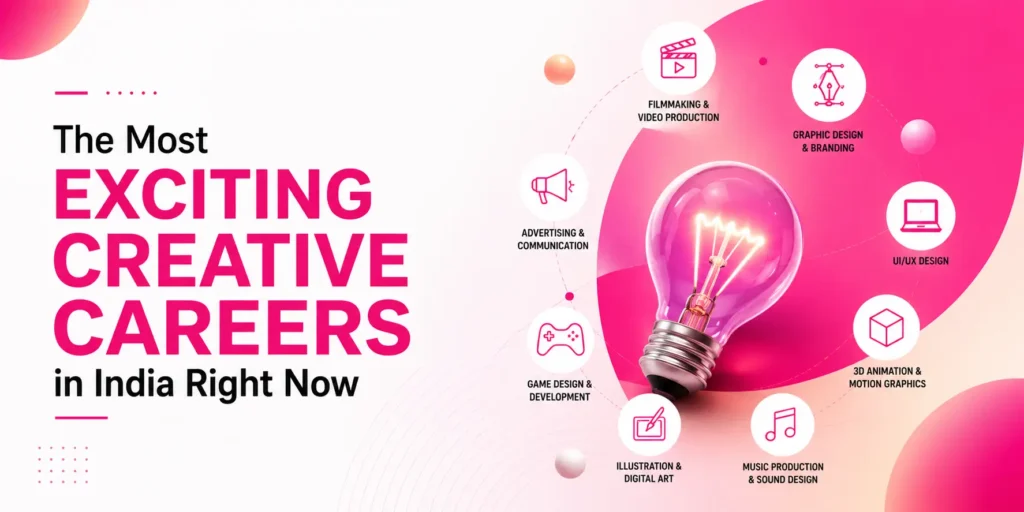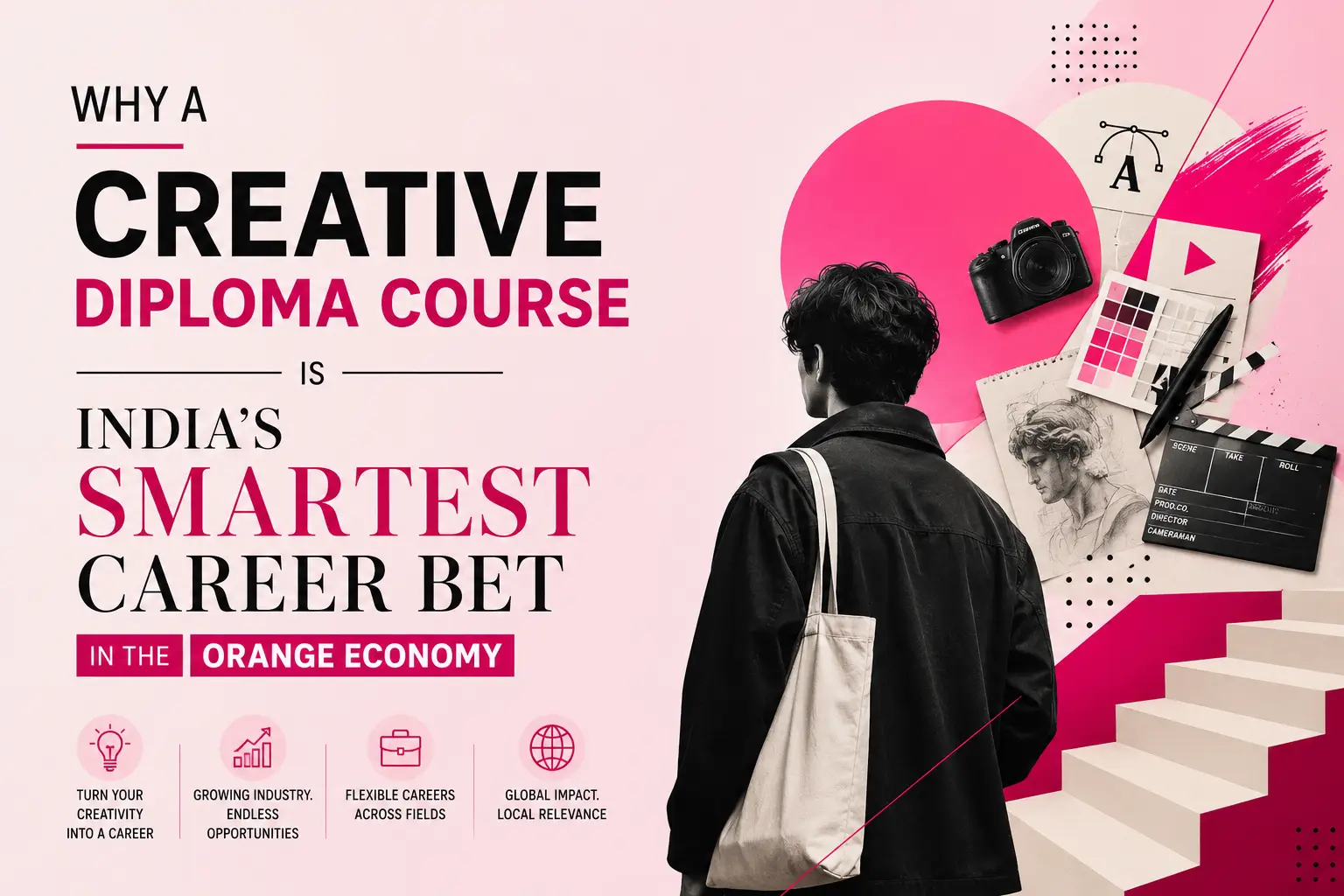
Many students complete Class 12 with a genuine talent for design, writing, or visual storytelling, only to face persistent questions about whether such interests can support a stable career. A creative diploma course is rarely the first option families consider, yet it may be one of the most practical routes available to young people in India today. Creative work was long regarded as a pastime rather than a profession. That perception is now outdated. India’s creative sector, widely referred to as the orange economy, has developed into a substantial source of employment and export earnings.
This blog looks at what a creative diploma actually teaches, how it compares with a traditional degree, and why the timing has rarely been better for students who want to build, not just memorise.
What is a creative diploma course, and what does it actually teach?
A creative diploma course is a focused, practice-led program that trains students in design, advertising, writing, branding, strategy, and digital media. Instead of long theory papers, it is built around live projects and a working portfolio. Most run for one to two years and prepare students directly for creative industry roles.
The exact creative diploma course subjects vary by college, but the core stays fairly consistent. Expect modules in graphic design, typography, copywriting, art direction, brand strategy, UX and interaction design, motion graphics, social media, and, increasingly, AI tools for creative production. The point is the range. A modern creative professional is expected to move between writing, visuals, and strategy, rather than sit in one narrow lane for an entire career.
Why does the orange economy make a creative diploma the right bet now?
The orange economy is the term for the creative industries: advertising, design, film, gaming, animation, content, and media. In India, this is no longer a fringe sector. According to the Observer Research Foundation, the country’s creative industry is estimated at around 35 billion US dollars, contributes roughly 8 per cent of national employment, and accounts for close to 20 per cent of overall gross value added. Those are not hobby numbers. They describe a real part of the economy.
The momentum is policy-backed as well. The Union Budget for 2026 to 2027 proposed setting up creative content labs across roughly 15,000 schools and 5,000 colleges, with the animation, visual effects, gaming, and comics sector projected to need close to two million professionals by 2030. The global picture rhymes with this. UNCTAD reported that creative services exports reached about 1.4 trillion US dollars worldwide in 2022. For a student deciding right now, that is a rare combination: work that is culturally satisfying and also has economic weight behind it.
Creative diploma vs degree: which one builds a career faster?
The honest answer is that it depends on what you want. A traditional degree offers breadth, a widely recognised qualification, and time to explore. A creative diploma trades some of that for speed, focus, and a portfolio you can show on day one. The creative diploma vs degree question is less about which is better in the abstract and more about which fits your goals. The table below lays the two side by side.
| Factor | Creative Diploma | Traditional Degree |
| Typical duration | One to two years | Three to four years |
| Core focus | Practical skills and portfolio | Theory with some application |
| You graduate with | A body of real project work | A certificate and broad knowledge |
| Industry exposure | Live briefs and internships built in | Often optional or limited |
| Best suited for | Students who want to start creating early | Students who want breadth and time |
| Main trade-off | Narrower but deeper and faster | Wider but slower to specialise |
What careers can a creative diploma course actually lead to?
A creative diploma opens onto a wide set of roles rather than a single job title. Graduates move into work as advertising executives, brand strategists, graphic designers, art directors, copywriters, content creators, media planners, and UX designers. Some go further and build their own studios or freelance practices. Because the work is portfolio-led, employers can see ability before an interview even begins, which often matters more than marks in this field.
This is also where the quality of the program shows. Institutions that teach through real client briefs, mentorship from working practitioners, and a portfolio-first model tend to produce more job-ready graduates.
NoMAD College of Creative Intelligence, for example, runs its programs around live projects, industry faculty, and AI-first studios, with a global exchange option through the Miami Ad School network. The aim is for students to leave with proof of work, not only a transcript.
How do you choose a creative diploma course worth your time?
Not every creative diploma is built the same way. Before you commit to fees and one or two years of your life, it helps to run any program through a short readiness checklist. Use the questions below as a filter when you compare options.
| What to check | Why it matters |
| Is it portfolio-first? | A strong portfolio is what gets you hired, more than the certificate itself. |
| Are there live client projects? | Real briefs teach deadlines, feedback, and teamwork that classrooms cannot fake. |
| Who teaches the program? | Working practitioners bring current industry standards and real networks. |
| Is there built-in internship exposure? | Internships convert learning into experience and often into first jobs. |
| Are modern and AI tools included? | Creative work now runs on digital and AI-assisted workflows. |
| Is there global or industry exposure? | Wider exposure builds confidence and a broader creative perspective. |
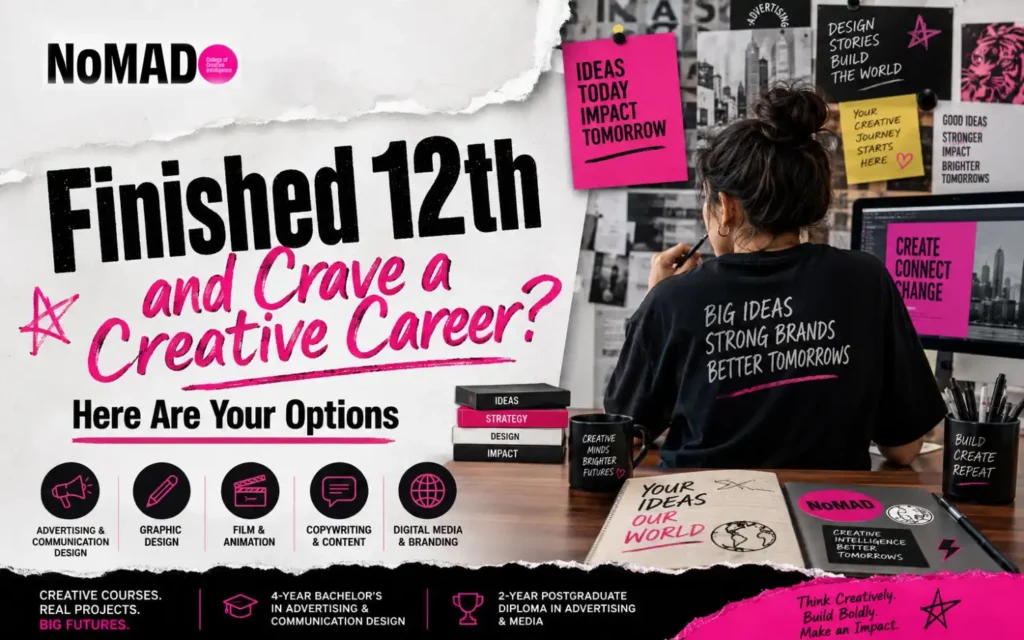
NoMAD College of Creative Intelligence was built around this kind of thinking. The main elements of its programmes encompasses:
University of Mumbai-backed undergraduate journey: The bachelor’s program carries the credibility of a recognised university qualification.
Postgraduate diploma run with Miami Ad School India: The advertising and media diploma is delivered in partnership with a globally established creative school.
Portfolio-first learning model: Both programs are built around portfolios rather than examination scores, so students graduate with demonstrable work.
Live briefs and real industry projects: Learning is structured around practical, industry-style assignments rather than theory alone.
Built-in internships: Internship exposure is integrated into the programs to convert classroom learning into professional experience.
Multidisciplinary training: Students develop skills across design, writing, strategy, and digital, rather than specialising too narrowly too early.
Campuses in Mumbai and Bangalore: Two metro locations place students within active, creative, and industry hubs.
Access to a global creative network: Students gain international exposure through NoMAD’s wider creative network.
If you are weighing a creative diploma seriously, it is worth seeing how a portfolio-first program runs in practice. Explore NoMAD’s programs or speak to the admissions team to understand what the journey would look like for you.
A practical close
The concern underlying the stability of creative careers is legitimate. Both students and parents need reassurance that a creative path can offer financial stability, long-term security, and professional respect. The evidence now points in a hopeful direction. The orange economy is expanding, public policy is backing creative skills, and employers increasingly hire for portfolios over pedigree. A creative diploma course fits that shift almost perfectly, because it places real work at the centre of learning rather than at the end of it.
If you are serious about turning a creative interest into a career, a focused, industry-led program is a smart place to begin. Explore what NoMAD College of Creative Intelligence offers, and take the first step toward building work that speaks for itself.
FAQs
Is a creative diploma course worth it in India?
Yes, for students who want to enter creative industries quickly. With the orange economy growing and employers hiring on portfolios, a practical diploma can lead to design, advertising, content, and strategy roles within a short, focused timeframe.
What subjects are taught in a creative diploma course?
Common creative diploma course subjects include graphic design, typography, copywriting, art direction, brand strategy, UX and interaction design, motion graphics, social media, and AI tools for creative production.
Is a creative diploma better than a degree?
Neither is universally better. A creative diploma vs a degree choice depends on your goals: a diploma is faster and portfolio-led, while a degree offers more breadth and time. Many creative employers value a strong portfolio over the qualification itself.
What is the orange economy?
The orange economy is another name for the creative industries, including advertising, design, film, gaming, animation, content, and media. In India, it contributes a meaningful share of employment and economic output.
What jobs can I get after a creative diploma?
Graduates work as advertising executives, brand strategists, graphic designers, art directors, copywriters, content creators, media planners, and UX designers. Some also become freelancers or start their own creative studios.
How long is a creative diploma course?
Most creative diploma courses run for one to two years, depending on the level and the institution. Postgraduate diplomas are usually two years and include internships or global exposure.
Do creative diploma courses include internships?
Many strong programs build internships into the structure so students gain real experience before they graduate. Always confirm internship details with the specific college before enrolling.
Related Posts