At first glance, a bachelor in communication design and a Bachelor of Fine Arts (BFA) can look like two names for the same creative path. In practice, they lead to very different places. Both build a strong foundation in visual thinking and craft, but one leans towards solving problems for brands and audiences, while the other centres on personal artistic expression. For any student weighing this choice after Class 12, this guide explains how the two degrees differ in focus, curriculum and career outcomes, so the right qualification can be matched to the right goal.
What Is the Core Focus of Each Degree?
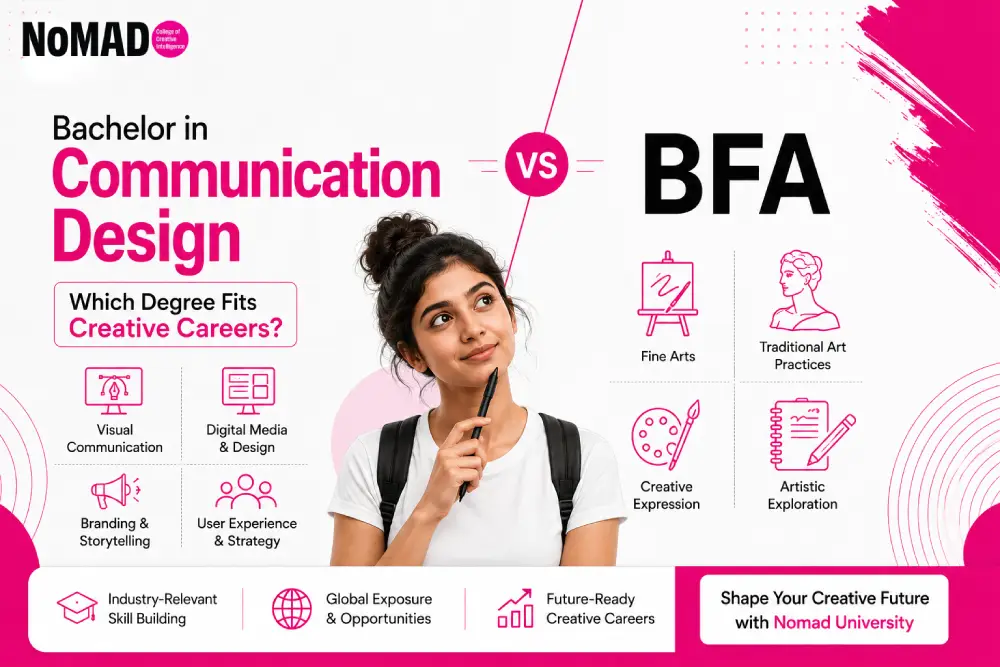
A bachelor in communication design and a BFA share a creative foundation, but they pursue different outcomes.
A bachelor’s in communication design is built around solving communication problems for audiences, brands and organisations. You learn to combine visual craft with strategy, using design to inform, persuade and engage. The emphasis is applied and commercial.
A BFA is built around personal artistic expression and studio practice. You develop technical skill in disciplines such as painting, drawing, printmaking and sculpture, and you explore concept, form and meaning. The emphasis is expressive and exploratory.
In short, communication design asks how a message reaches people, while a BFA asks what an artist wants to express.
If you want a closer look at the degree itself, our detailed bachelor in communication design guide breaks down the subjects, skills and outcomes in full.
How Do the Curricula Differ?
The curriculum is where the two degrees separate most clearly. A bachelor in communication design blends design craft with digital tools, strategy and real briefs. A BFA centres on studio time, art history and the development of an individual body of work.
Applied Design and Commercial Craft
A communication design curriculum typically covers subjects such as:
● Graphic design, typography and visual communication
● Branding and brand identity
● Advertising and creative strategy
● User experience (UX) and interaction design
● Digital imaging, motion graphics and social media
● Portfolio development for industry
The goal is employability. Projects often mirror real client work, so you graduate with a portfolio that speaks to studios, agencies and brands.
Fine Arts and Studio Practice
A BFA curriculum typically covers subjects such as:
● Drawing, painting and colour theory
● Sculpture, printmaking and mixed media
● Art history and critical theory
● Studio practice and independent projects
● An exhibition portfolio of original artworks
The goal is artistic depth. You build a body of work that reflects your individual voice, often geared towards exhibitions, residencies or further study.
Which Careers Does Each Degree Lead To?
Career direction is often the deciding factor.
A bachelor in communication design commonly leads to roles such as graphic designer, brand designer, art director, UX or UI designer, visual designer, advertising creative, motion designer and social media designer. These roles sit inside agencies, design studios, brands, media companies and technology firms.
A BFA commonly leads to roles such as fine artist, illustrator, studio artist, art educator, and gallery or museum professional. Many BFA graduates also pursue independent practice or postgraduate study.
There is overlap. Some BFA graduates move into commercial design, and some communication designers create fine art. The difference is the direction each degree prepares you for first.
If you are comparing creative courses after Class 12, it helps to see how an applied programme is structured. Explore NoMAD’s Bachelor’s in Advertising and Communication Design to understand the curriculum, portfolio focus and admissions process before you decide.
Which Degree Builds a More Commercial Portfolio?
For commercial and industry roles, a bachelor in communication design usually builds a more directly employable portfolio.
Communication design portfolios are project-led and outcome-focused. They show campaigns, brand systems, digital interfaces and design solutions that respond to a brief. Employers in advertising, design and technology look for exactly this kind of applied work.
BFA portfolios are body-of-work focused. They show artistic range, concept and technical mastery, which suits galleries, residencies and creative practice, and can also support design roles when paired with commercial projects.
If your priority is agency, studio or brand employment, an applied portfolio built through live briefs and real projects gives you a stronger starting point. This is why applied programmes place so much weight on portfolio development from the first year.
How Do You Decide Between Them?
The right choice depends on your goals, your working style and the kind of creative life you want.
Match the Degree to Your Goals
Use this comparison to guide your thinking:
| Aspect | Bachelor in Communication Design | Bachelor of Fine Arts (BFA) |
| Core focus | Applied, commercial design and visual communication | Fine arts and personal studio practice |
| Typical subjects | Branding, advertising, typography, UX, digital media | Painting, sculpture, drawing, printmaking, art history |
| Portfolio type | Project and brief-led, industry-facing | Body of work, exhibition-focused |
| Common careers | Graphic designer, art director, UX designer, advertising creative | Fine artist, illustrator, studio artist, art educator |
| Best suited to | Students aiming for agency, studio, brand or technology roles | Students aiming for artistic practice and exhibitions |
Questions to Ask Each College
Before you apply, ask each college:
● What does the curriculum cover, semester by semester?
● How much of the learning is based on real briefs and live projects?
● What kind of portfolio will I graduate with?
● What internships, mentorship and industry exposure are offered?
● What careers do recent graduates go into, and how is that supported?
Clear answers tell you whether a programme is applied and industry-facing or studio and practice-led.
Communication Design at NoMAD
NoMAD College of Creative Intelligence offers a four-year Bachelor’s in Advertising and Communication Design, delivered in partnership with Miami Ad School India and backed by the University of Mumbai. The programme is built for students who want an applied, industry-facing creative education.
Learning at NoMAD is hands-on and portfolio-first. Students work on real client projects and live briefs, collaborate in teams, and receive mentorship from practising professionals across advertising, branding, design and strategy. The curriculum moves from foundation craft such as typography, graphic design and visual expression into applied areas such as UX design, brand strategy, digital campaigns and portfolio development.
NoMAD has campuses in Mumbai and Bangalore, with Mumbai positioned as India’s creative capital. Students also gain access to national and international internships and a global exchange pathway, supported by creative learning spaces such as studios, labs and a dedicated design environment.
For students weighing a bachelor in communication design against a BFA, an applied programme like this offers a clear route into commercial creative careers. You can also see how NoMAD builds portfolios through real client work to understand what employability-focused learning looks like in practice.
Frequently Asked Questions
Is communication design better than a BFA?
Neither degree is better in absolute terms; they suit different goals. A bachelor in communication design suits commercial, industry-facing careers in branding, advertising and digital design. A BFA suits fine arts practice, exhibitions and independent artistic work. Choose the degree that matches the creative career you want to build.
Can BFA graduates work in advertising?
Yes. BFA graduates can work in advertising, particularly in art direction, illustration and conceptual roles, especially when they build a commercial portfolio alongside their studio work. A communication design or advertising degree usually offers more direct preparation, because the curriculum is built around briefs, branding and campaigns.
Which has better job prospects, communication design or a BFA?
Job prospects depend on the role, location and the strength of your portfolio rather than the degree name alone. Applied programmes such as communication design are designed around industry employability, while a BFA supports artistic and studio-led paths. Compare recent graduate outcomes at each college before deciding.
What is a bachelor in communication design?
A bachelor in communication design is an undergraduate degree focused on solving visual and communication problems for brands and audiences. It combines graphic design, typography, branding, advertising, user experience and digital media with creative strategy, and it builds an industry-ready portfolio for creative careers.
Do I need to be good at drawing for a communication design degree?
Drawing helps, but it is not essential. Communication design values ideas, visual thinking, layout, typography and problem solving as much as hand-drawing skill, and much of the work is digital. A BFA, by contrast, places far greater emphasis on traditional drawing and studio technique.
Which degree is better for an advertising career after Class 12?
For a focused advertising career after Class 12, an advertising and communication design programme is usually the more direct route, because it teaches branding, copy, campaigns and digital craft through real briefs. NoMAD’s Bachelor’s in Advertising and Communication Design is one example of an applied programme built for this path.
Choose Your Creative Degree at NoMAD
The choice between a bachelor in communication design and a BFA comes down to the creative career you want to build. If you are drawn to branding, advertising, digital design and applied creative work, an industry-facing communication design programme is the natural fit.
NoMAD College of Creative Intelligence combines portfolio-first learning, real client projects, practitioner-led mentorship and global internship exposure across its Mumbai and Bangalore campuses.
To talk through your options, curriculum and portfolio, speak to a NoMAD admissions counsellor for guidance on the programme and the application process. You can also download the programme brochure for the full curriculum.
Related Posts