You already have a body of work. A few designs, an idea for a campaign, two or three posts that performed well. Then you open the application, and one question holds you in place: what does a creative portfolio internship application actually need in order to stand out? The reflex is to pile on more. More projects, more screenshots, more pages. Recruiters do not work that way. They are not adding up your pages. They are watching for a signal, and within a few seconds, they decide whether to keep reading or set your folder aside.
This guide is about those few seconds. It lays out the seven pieces that consistently make recruiters pause, and the reason each one belongs in your portfolio. The goal is not to make the folder bigger. The goal is to make it sharper.
What makes a creative portfolio internship application work?
A creative portfolio internship application works when it shows thinking, not only output. Recruiters want to see how you framed a problem, what you decided, and what you produced as a result. Six to eight focused pieces, each with a short note on your role and intent, almost always outperform twenty unexplained images.
If you are wondering how to build a creative portfolio for internship applications, the list below is a practical starting point. Treat it as a checklist rather than a rule, and adapt it to the kind of creative portfolio internship you are chasing.
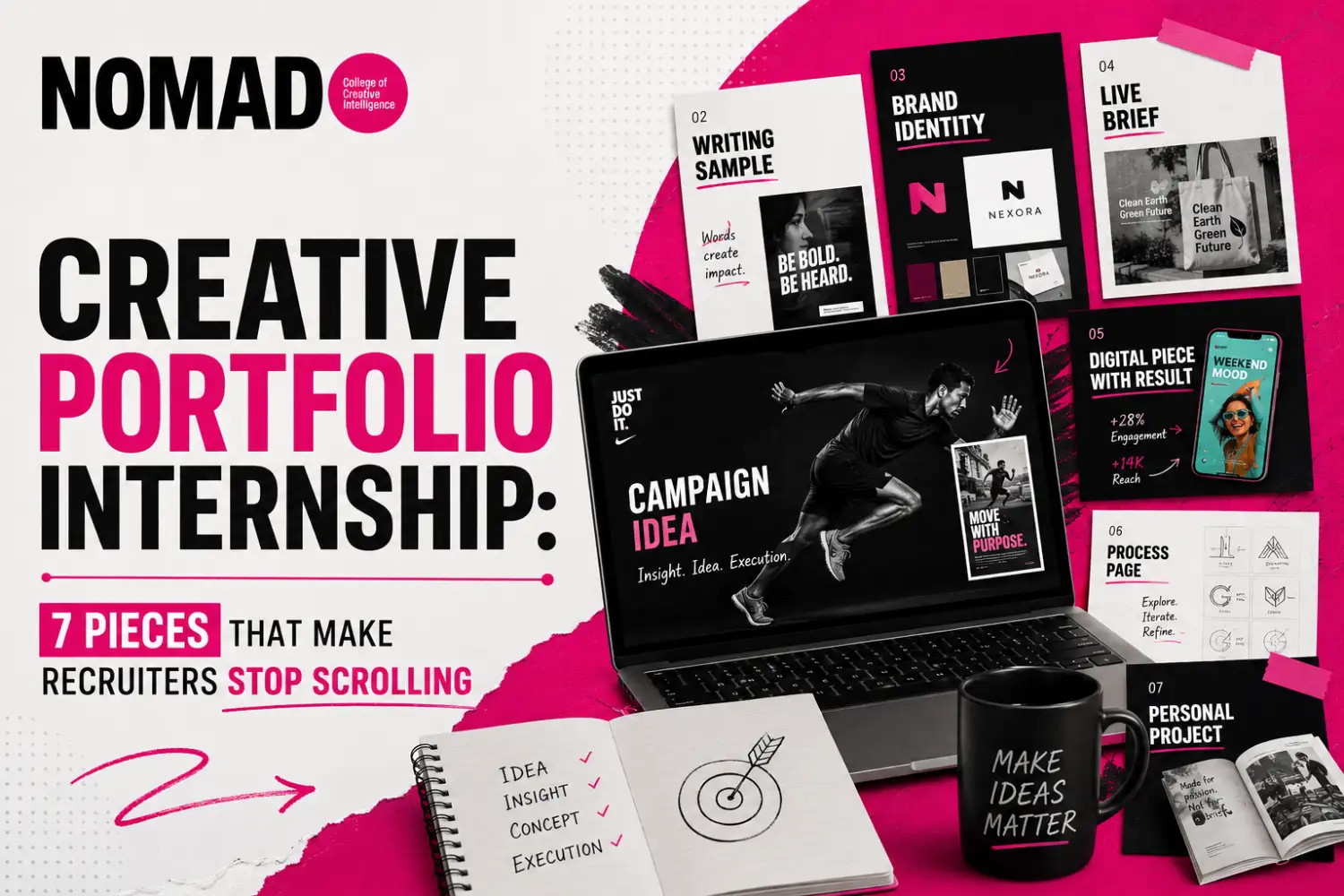
The 7 portfolio pieces that make recruiters stop scrolling
1. One campaign idea, explained from brief to execution
A single, well-argued campaign beats a folder of pretty visuals. Show the brief, the insight you found, the idea, and one or two finished executions. This is the piece that proves you can think like a strategist and build like a maker, which is exactly what a creative portfolio for advertising internship roles is screened for.
2. A piece that proves you can write
Even visual roles value clear writing. Include a headline set, a short script, or a piece of brand copy. Writing reveals how you think, and a sharp line often stays in a recruiter’s memory longer than another mockup.
3. A branding or visual identity exercise
Pick a brand, real or imagined, and build a small identity system: a logo direction, type, colour, and one application. This shows range and an eye for consistency, two qualities studios look for early.
4. A real or live brief, however small
Work made for an actual person, club, shop, or cause carries weight that classroom projects rarely match. It signals that you can handle feedback, constraints, and deadlines. If you have never had a live brief, that gap is worth closing before you apply.
5. A social or digital piece with a result
Add one piece tied to a measurable outcome: a post that grew reach, a reel that performed, a small page you designed and shipped. Numbers are not mandatory, but evidence of impact separates you from applicants who only show concepts.
6. A process page
Recruiters often value the messy middle more than the polished end. One page of sketches, rejected directions, and short notes on why you chose what you chose tells them how you will behave on the job.
7. A personal project that shows your taste
End with something you made for yourself: a zine, an illustration series, a typeface, or a photo set. This piece carries no brief and no client. It simply shows who you are as a maker, and it is often what a recruiter remembers.
Portfolio piece versus what it proves
Use this quick reference while auditing your own folder. Each piece should earn its place by proving something specific:
| Portfolio piece | What recruiters read from it | Best for |
| Campaign idea (brief to execution) | Strategic thinking and craft together | Advertising, art direction, copywriting |
| Writing sample | Clarity of thought and a distinct voice | Copywriting, content, communications |
| Branding or identity exercise | Consistency and visual judgment | Design, branding, art direction |
| Real or live brief | Reliability under real constraints | All creative internships |
| Digital piece with a result | Evidence of measurable impact | Social media, digital marketing, media planning |
| Process page | How you work, not only what you make | All creative internships |
| Personal project | Taste, originality, and drive | All creative internships |
What is the best website to host a creative portfolio for an internship?
For most students, a clean personal website or a Behance profile is the best website to host a creative portfolio for an internship, supported by a single PDF version for email applications. Choose a platform that loads fast, reads well on a phone, and lets the work speak without heavy decoration. The host matters far less than the order and clarity of the pieces inside it. Lead with your strongest work, because the first scroll decides whether there is a second.
How NoMAD helps students build internship-ready portfolios
Knowing what to include is one thing. Building it under real conditions is another. This is where a portfolio-first education changes the equation. At NoMAD College of Creative Intelligence, students work on live briefs and real client projects from early on, which means the portfolio is not assembled in a panic before applications. It is built steadily through the course itself.
The undergraduate journey, backed by Mumbai University, dedicates a full stage to portfolio development, and the final year is structured around national and international internships. Faculty are working practitioners from agencies and studios, so feedback reflects what recruiters actually look for. Through its connection with Miami Ad School and a wider global network, students also gain exposure beyond a single market, which strengthens a creative portfolio for advertising internship applications at international agencies.
If you are serious about turning creative interest into a career, explore how the NoMAD portfolio-first program is structured, and speak to the admissions team about how the internship pathway works.
Conclusion
Most students treat a creative portfolio internship application as a numbers game and lose attention on the first scroll. The fix is not more work. It is a small set of pieces that each prove something specific: how you think, how you write, how you design, and how you behave under a real brief. Build those seven well, host them simply, and you give a recruiter a reason to stop and read.
If you want that portfolio to develop through real projects rather than rushed weekend builds, consider a program designed around it.
Explore NoMAD programs or book a counselling session to understand the journey before you apply.
FAQ Section
What should a creative portfolio internship include?
A campaign idea, a writing sample, a branding exercise, a live brief, a digital piece with a result, a process page, and one personal project. Six to eight strong pieces are enough.
How many pieces should a creative portfolio have?
Quality over quantity. Six to eight focused pieces, each with a short note on your role, are usually stronger than twenty unexplained images.
How do you build a portfolio without internship experience?
Use self-initiated and live briefs. Redesign a brand you admire, create a campaign for a local cause, or build a small project for a real person. Work made for real situations counts.
What is the best website to host a creative portfolio for an internship?
A clean personal website or a Behance profile works well, with a PDF version for email applications. Prioritise fast loading and mobile readability.
Do creative internships in advertising require a portfolio?
In most cases, yes. A portfolio is the main way agencies and studios assess creative ability, often before grades or a resume.
How long should a creative portfolio be?
Short enough to hold attention. Lead with your strongest piece, and remove anything you would not be able to defend in an interview.
Related Posts