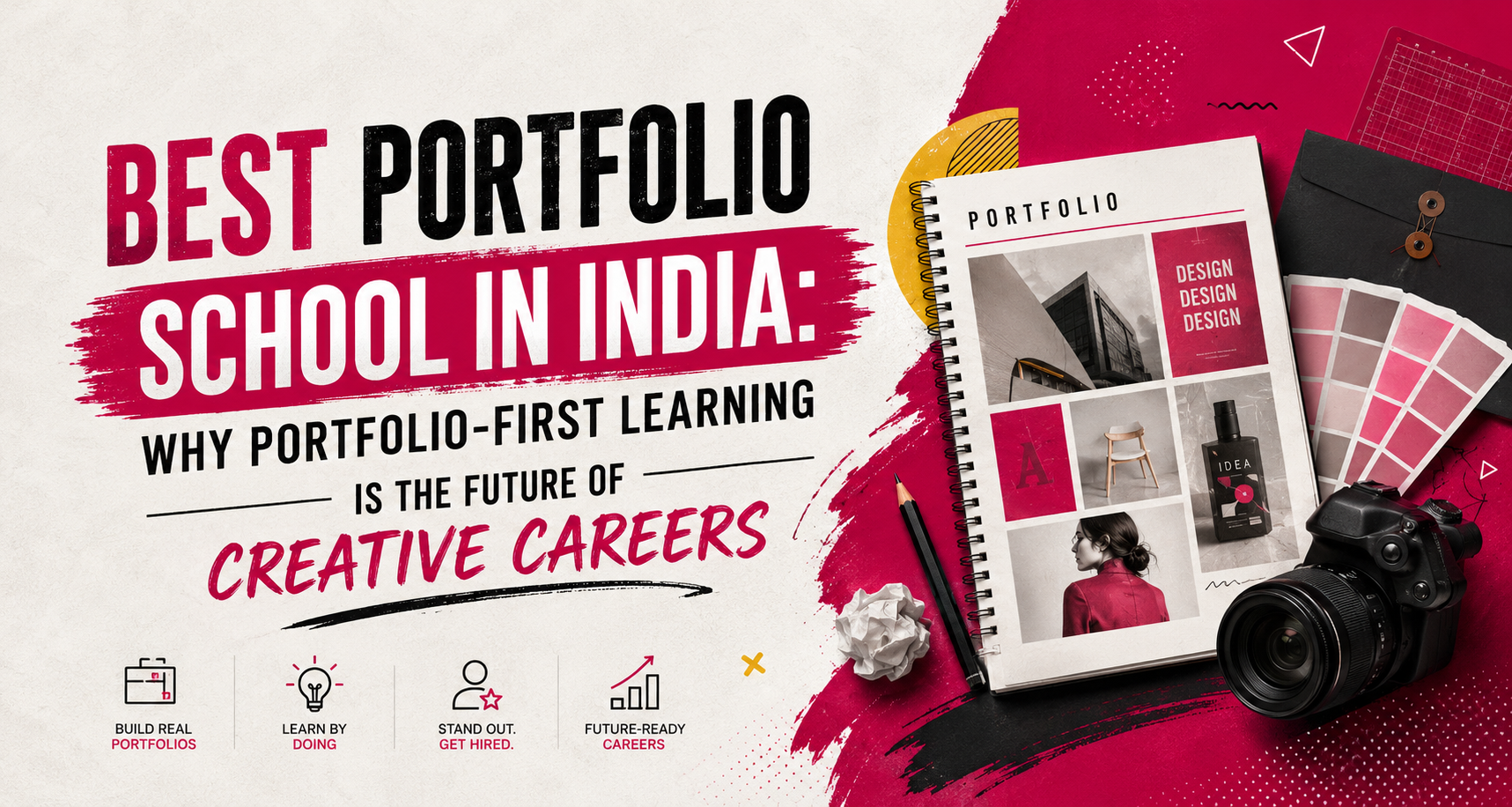
If you are comparing the best portfolio schools in India, you are likely past the stage of wondering whether a creative career is viable. The real question is which program will get your work to a level where the right agency takes notice.
The answer depends on three things:
- Who is teaching you
- What briefs are you working on
- Where are graduates actually getting placed?
A well-known name on your degree means less than a well-crafted campaign in your book.
This guide evaluates the best portfolio schools in India across all three criteria, so you can make a decision based on outcomes, not marketing copy.
What Is a Portfolio School, and Why Does It Matter in India?
A portfolio school is a creative education institution where students learn by building a body of real work, not by memorising theory for exams. In India, portfolio schools focus on advertising, design, branding, and digital media, and they prepare students to enter agencies and studios with an interview-ready portfolio rather than a certificate alone.
That definition matters more than it sounds. When people ask what a portfolio school is now home to, they are usually comparing it against a traditional degree. A degree records that you attended. A portfolio proves what you can make. In creative hiring, the second one carries the conversation.
A strong portfolio is not a folder of pretty images. It is evidence of how you think. It shows the problem you were given, the idea you chose, the work you produced, and the result it aimed for. Reviewers can read your judgment in it within minutes, which is exactly why portfolio-building programs for creatives in India have grown so quickly.
Why Are Creative Employers Moving Away From Degrees Alone?
Creative work has changed faster than most syllabi. Tools shift every year, platforms appear and fade, and clients expect ideas that travel across film, social, packaging, and digital at once. A fixed three-year theory course struggles to keep pace. A body of real work does not, because it is built in the present.
Artificial intelligence has sharpened this further. Routine production tasks are being automated, while the human ability to frame a problem, judge an idea, and connect unrelated thoughts is becoming more valuable, not less.
The World Economic Forum has projected that AI and automation will create millions of new roles even as older tasks disappear, and the roles that survive reward originality over rote knowledge. For a creative student, the lesson is direct: build proof that you can think, not just proof that you attended.
What Should the Best Portfolio School in India Actually Offer?
Not every programme that uses the word portfolio earns the title. Use the comparison below to see the real difference, then run any college you are considering through the checklist that follows.
Degree First College vs Portfolio First School
| What changes | Degree-first college | Portfolio-first school |
| Graded on | Exams and attendance | Quality of the work you produce |
| You graduate with | A certificate | A certificate and an interview-ready portfolio |
| How you learn | Lectures and fixed theory | Live briefs, real projects, and feedback |
| Industry exposure | Occasionally, often optional | Built into the course through mentors and internships |
| Hiring readiness | Depends on what you did outside class | Demonstrated by the portfolio itself |
| Best suited for | Students who want a broad, general degree | Students set on a creative career |
Checklist: How to Evaluate the Best Portfolio School in India
• Real client work or live briefs, not only classroom assignments.
• Faculty who are working practitioners from agencies, studios, and brands.
• Structured portfolio development is built into the curriculum, not left to the student.
• Internships that are part of the programme, with clear duration and support.
• Exposure to current tools, including AI-assisted creative workflows.
• Global or cross-cultural exposure, since creative work is rarely local.
• A recognised academic backing, so the qualification holds weight.
• Honest, verifiable claims about outcomes rather than vague guarantees.
How Does Portfolio First Learning Build a Real Career?
The path is more practical than it first appears. You learn a skill, you apply it to a brief, you receive feedback from someone who works in the field, and you keep the strongest output. Repeat that across a few years, and you do not end up with a transcript. You end up with a case for yourself that a creative director can read.
This is the model that institutions like NoMAD College of Creative Intelligence are built around. Its undergraduate and postgraduate programmes are portfolio-first and industry-led, taught through live briefs and real projects, with internships built into the journey and a Mumbai University-backed structure behind the undergraduate course. For students who want creative work to become a career rather than a hobby, that combination of real work and academic backing is the point.
Where Does NoMAD Fit Into Portfolio-First Education?
NoMAD positions itself for students who want to build, not just study. The learning model is hands-on, with real client projects, collaboration in teams, and mentorship from practising industry creatives rather than heavy theory or an outdated syllabus.
It is connected with Miami Ad School and a wider global creative network, with a global exchange element that lets students study and intern beyond India. The faculty is drawn from agencies and studios, the studios are built around current and AI-assisted creative tools, and admission runs through creative exercises rather than marks alone. Programmes include a four-year Bachelor’s in Advertising and Communication Design and a postgraduate diploma in Advertising and Media. None of this is a promise of a specific job, and it should not be read as one. It is a structure designed to improve career readiness by making sure you graduate with work worth showing.
The Bottom Line for a Creative Student
The student problem we started with does not disappear, but it does become clearer. The colleges that all sounded the same are not the same once you ask one question: Will I leave with proof of what I can make? In a market where AI handles the routine, and employers reward original thinking, that proof is your career capital. This is the real reason the best portfolio school in India for you is the one that treats your portfolio as the product of the entire course, not an afterthought.
If that is the kind of creative education you want, NoMAD College of Creative Intelligence is worth a serious look. Book a counselling session or visit the campus to see how a portfolio-first program could shape your next four years.
FAQ Section
What is a portfolio school in India?
It is a creative education institution where you learn by building real work in advertising, design, branding, and digital media, and you graduate with an interview-ready portfolio rather than only a certificate.
Is a portfolio more important than a degree for creative jobs?
For most creative roles, the portfolio carries the interview because it shows what you can actually make. A recognised qualification still helps, so the strongest programmes give you both.
Which is the best portfolio school in India for advertising and design?
The best choice is the one offering live client work, practitioner faculty, built-in internships, current tools, and honest outcomes. NoMAD College of Creative Intelligence is one portfolio-first option built around these elements.
How do I build a creative portfolio after Class 12?
Start with real briefs, solve them with original ideas, and keep your strongest outputs. A portfolio-first program structures this for you so your folder grows alongside your skills.
Can a portfolio-first program lead to a stable creative career?
It improves your readiness for creative roles by making sure you graduate with proof of skill. No honest program guarantees a specific job, so judge each one on its work, mentors, and verified outcomes.
Does NoMAD offer global exposure?
NoMAD describes a connection with Miami Ad School and a global creative network, with exchange and international internship elements. Confirm the current details with the admissions team.
Related Posts