Right after Class 12, the suggestions start pouring in. Friends, relatives, and coaching ads all have an opinion: motion graphics, UI animation, animation, VFX. If you enjoy watching design move on a screen, choosing a motion graphics course India can feel oddly confusing, mostly because no one breaks down what actually separates these fields.
The confusion is fair. The two fields look similar from the outside. Both involve movement, both reward a strong design eye, and both use overlapping software. Yet they lead to different studios, different clients, and very different day-to-day work.
This guide breaks down what each path actually involves, who it suits, and how to decide without guessing. By the end, you will know which direction fits your interests and what to look for in a program before you commit.
What is a motion graphics course India?
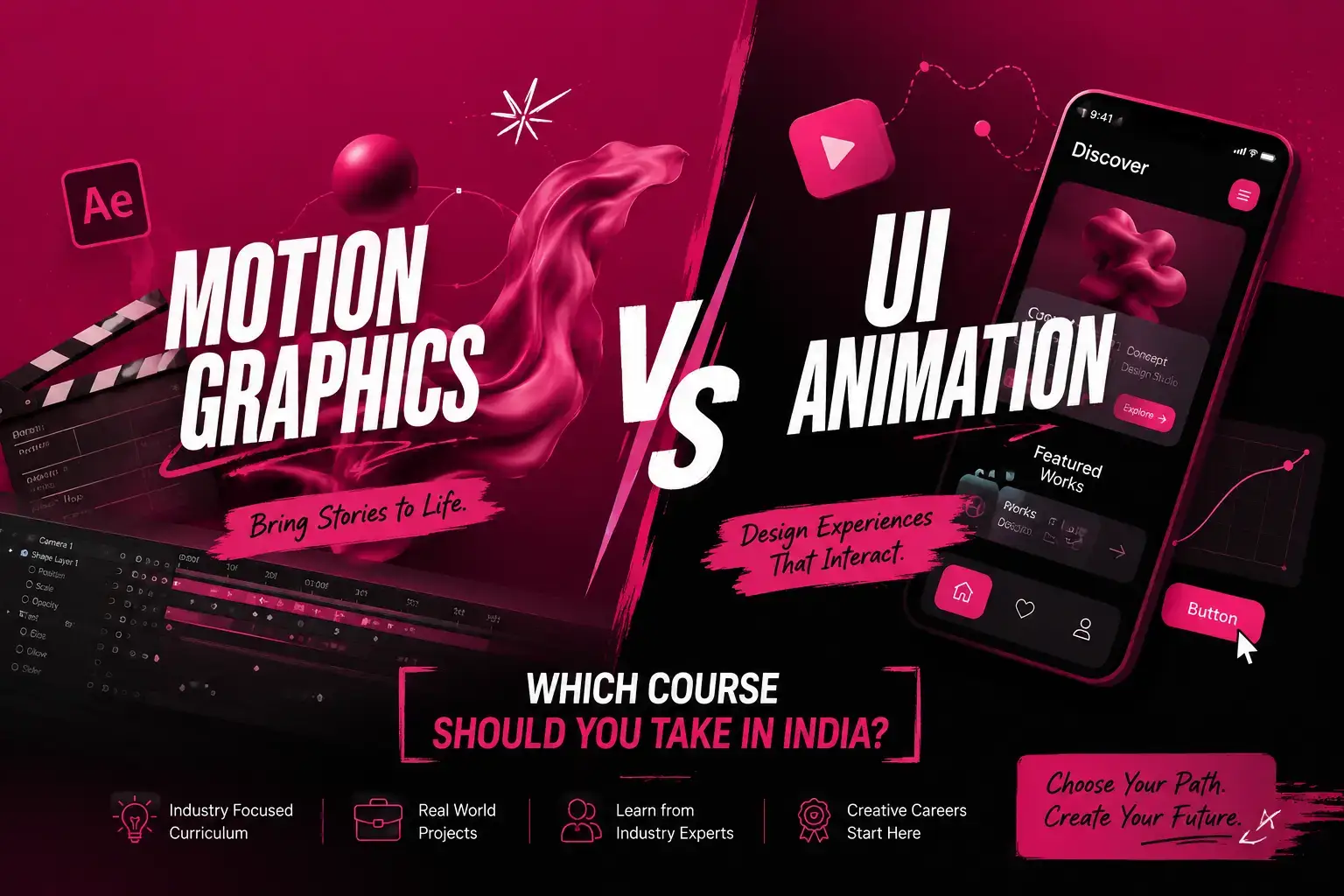
A motion graphics course India teaches you to animate graphic design: logos, text, icons, infographics, and brand elements that move. You learn tools such as Adobe After Effects and Cinema 4D, along with the design and storytelling principles behind explainer videos, title sequences, social media content, and broadcast graphics.
In practice, motion graphics live where advertising, branding, and content meet. Think of the animated intro on a brand’s YouTube channel, the data visualisation in a startup pitch, or the punchy three-second loop on an Instagram reel. A motion designer takes a static idea and gives it rhythm.
What is UI animation, and how is it different?
UI animation, sometimes called motion for interfaces or UX motion, is about how digital products behave. It covers the small, deliberate movements inside apps and websites: a button that responds to a tap, a screen that slides in, a loading state that keeps you patient, a menu that opens with intent.
The tools shift here, too. Alongside After Effects, you work with Figma, ProtoPie, Principle, and Rive, often exporting lightweight files such as Lottie that developers drop straight into an app. UI animators usually sit inside product or design teams, close to engineers and UX designers.
So the difference is not really about software. It is about purpose. Motion graphics is built to communicate and persuade. UI animation is built to guide and to make a product feel effortless.
Motion graphics vs UI animation: what is the real difference?
People often search for a “motion graphics vs animation course India” comparison and assume the two are the same. Traditional animation tells stories with characters, frame by frame. Motion graphics animate design and information. UI animation is a third, narrower craft focused on screens you can touch.
Here is how the two paths compare side by side.
| Factor | Motion Graphics | UI Animation |
| What you create | Animated design, explainers, titles, brand and social content | Micro-interactions, transitions, app and web motion |
| Where it is used | Advertising, branding, OTT promos, social media, events | Apps, websites, SaaS products, digital services |
| Core tools | After Effects, Cinema 4D, Illustrator | Figma, ProtoPie, Rive, Lottie, After Effects |
| Works closely with | Art directors, copywriters, brand teams | UX designers, product managers, developers |
| Key skills | Visual storytelling, timing, typography | Interaction logic, usability, prototyping |
| Typical roles | Motion designer, broadcast designer, content creator | UX motion designer, product designer, interaction designer |
| Best for you if | You enjoy ideas, brands, and visual impact | You enjoy products, logic, and user experience |
Which course should you choose?
Start with a simple question: do you want your work to be watched, or to be used? If you are drawn to campaigns, brands, and content that grabs attention, the motion graphics course India will feel like home. If you are fascinated by how apps feel and how people move through them, UI animation will suit you better.
There is also an honest truth worth saying early. Very few students know the answer at seventeen, and that is fine. The strongest creative careers today are rarely single-skill. A motion designer who understands interfaces and a UI animator who can tell a brand story will always have more options. This is exactly why a portfolio-first creative program, rather than a narrow single-tool course, often serves students better in the long run.
If you are still weighing your options, it helps to speak to people who do this work for a living.
Where Does NoMAD College of Creative Intelligence Fit Into Your Creative Career?
Skilled motion talent is genuinely in demand, and the numbers back this up. According to the FICCI-EY 2026 media and entertainment report, India’s animation, VFX, and post-production segment is projected to grow to roughly Rs 138 billion by 2028. Motion graphics and UI animation sit within an even wider creative economy that also spans advertising, branding, and digital products, which means the skills travel across many industries.
This is where the choice of where you study matters as much as what you study. At NoMAD College of Creative Intelligence, motion graphics, interface and interaction design are not treated as isolated software classes. They sit inside a complete creative education built around the following strengths:
- A Mumbai University-backed degree: A four-year program in advertising and communication design, with motion and interaction design taught as part of the whole, not as add-on tool courses.
- Live briefs and real client projects: Students work on actual industry briefs and real client work, not only classroom exercises.
- AI-first studios: Learning takes place inside AI-first studio spaces.
- A hiring-ready portfolio: Students build the kind of portfolio that hiring teams actually ask to see.
- Mentorship from practising industry creatives: Guidance comes from professionals who are currently working in the creative industry.
- National and international internships: The final year opens into internship opportunities in India and abroad, accessed through NoMAD’s global creative network and its Miami Ad School connection.
In other words, you do not have to gamble everything on one specialisation at the start. You build range, prove it through work, and let your portfolio point you toward the role that fits.
Conclusion
The real problem was never motion graphics versus UI animation. It was the lack of a clear, honest explanation of what each path involves and where it leads. Motion graphics rewards storytellers who love brands and visual impact. UI animation rewards problem-solvers who care about how products feel. Both are growing, both are respected, and both reward a strong portfolio far more than a perfect mark sheet.
If you are serious about turning a creative interest into a career, the smartest first step is choosing an environment that lets you explore both before you commit to one.
To see how a motion graphics course India can sit inside a broader, industry-led creative education, explore NoMAD’s program or book a counselling session with the admissions team.
G. FAQ Section
What is a motion graphics course India?
It is a program that teaches you to animate graphic design, such as logos, text, and brand elements, using tools like After Effects and Cinema 4D for use in advertising, social media, and video content.
Is motion graphics a good career in India?
Yes. Motion designers are needed across advertising, OTT, social media, and branding, and the wider creative and media economy continues to grow, which keeps demand steady for skilled professionals.
What is the difference between motion graphics and UI animation?
Motion graphics communicate and persuade through animated design and content. UI animation guides users through apps and websites with transitions and micro-interactions inside product teams.
Which is better, motion graphics or UI animation?
Neither is better overall. Motion graphics suits students who love brands and storytelling. UI animation suits those who enjoy products, logic, and user experience.
Do I need a degree to work in motion graphics or UI animation?
A portfolio matters most in both fields. A strong program helps because it gives you real projects, mentorship, and the structured practice needed to build that portfolio.
Can I learn both motion graphics and UI animation?
Yes, and many of the most flexible creatives do. A portfolio-first program that covers design, motion, and interaction lets you build range before specialising.
Which software should I learn first?
Adobe After Effects is the common starting point for both paths. From there, motion designers add Cinema 4D, while UI animators add Figma, Rive, and prototyping tools.
Related Posts