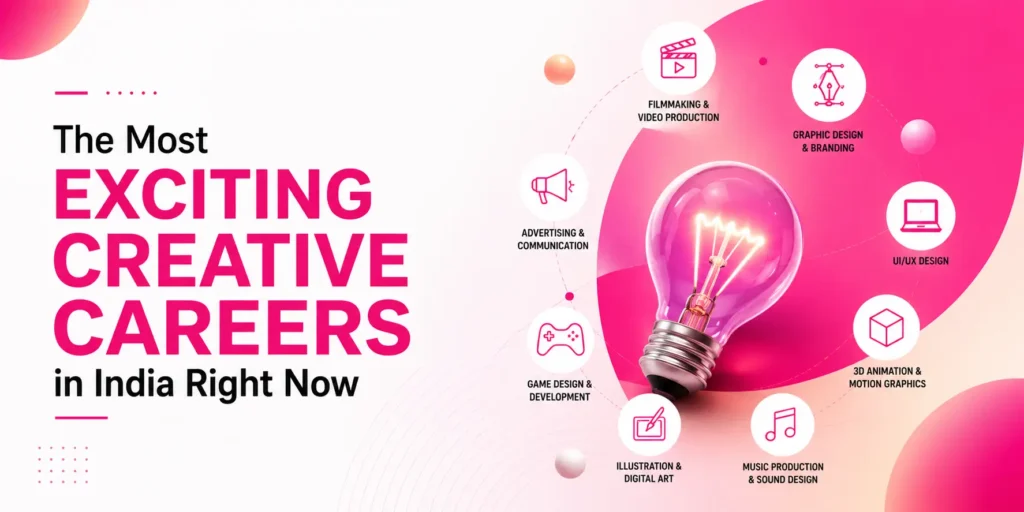
Choosing what to study after 12th can feel like everyone already has the answer except you. Engineering and medicine dominate the conversation, and if neither excites you, it’s easy to assume you’ve missed something. You haven’t. Wanting a design course after 12th, one that lets you create, build, and solve problems visually, is a legitimate, growing path, not a fallback. From graphic design and communication design to advertising and newer hybrid fields, the range of creative education available in India has expanded dramatically, and much of it is genuinely worth your attention.
This guide cuts through the noise: the actual design courses you can pursue after 12th, the signs of a creative college that will develop you, and a clear-eyed way to check whether your strengths match the work.
Why Choose a Design Course After 12th?
The design industry in India is growing rapidly. Every brand needs designers. Every business needs communication specialists. Every startup needs people who can think creatively and solve complex problems. But beyond industry demand, a design course after 12th is right for students who are energised by making things, not memorising content. You prefer sketching to studying. You see problems as visual puzzles. You want your education to prepare you to create, not merely consume.
Choosing a design course after 12th means entering a field where your portfolio matters more than your board scores. It means learning alongside professionals who have worked on real campaigns, real brands, and real briefs. And it means spending your university years building work you can be proud of, rather than cramming theory you will forget after exams.
The creative industries across advertising, branding, digital media, product design and motion graphics are actively hiring graduates from structured design programmes. If you choose well, by the time you finish your degree, you will have a portfolio of work, industry connections, and the practical skills to earn a living from what you love.
Which Design Fields Can You Explore?
Communication and Graphic Design
Communication design is the most established design field in India. It covers graphic design, typography, editorial design, visual identity, branding, and poster design. Communication design courses teach you how to arrange text, imagery and colour to convey a message clearly and compellingly.
Graphic design and communication design roles exist in advertising agencies, branding studios, publishing houses, media companies, and in-house creative teams at large corporations. The work ranges from designing advertising campaigns and brand identities to creating content for social media and digital platforms.
A design course after 12th in communication design will cover design fundamentals, design history, typography, colour theory, software skills (Adobe Creative Suite), photography, and how to develop visual narratives. The strongest programmes combine these technical skills with real client projects so that you are not just learning concepts but applying them.
UI/UX, Motion and Beyond
User experience design and interface design are the fastest-growing design fields in India. UI/UX designers create digital products: apps, websites, dashboards, platforms. They think about how users interact with technology and design experiences that are intuitive, accessible and delightful. Motion graphics and animation specialise in moving imagery, crucial for social media, advertising and digital storytelling.
These fields require a mix of creativity and structured thinking. You need to understand design principles, but also user research, information architecture, prototyping and testing. A comprehensive design course after 12th that covers these areas will teach you both design and the technology behind it.
Many undergraduates start with broad communication design education and then specialise in UI/UX or motion graphics during their final years, once they have developed foundational skills.
Do You Need a Science or Arts Background?
This is one of the most common questions prospective design students ask. The short answer is no. Design courses after 12th do not require a science background. You do not need advanced mathematics or chemistry. You do not need to have excelled in STEM subjects.
What matters far more is your ability to think creatively, communicate visually, and work through complex problems. Colleges that specialise in design recognise this and recruit students from all academic backgrounds, including Arts, Commerce and Science streams. Many of the world’s best designers came from humanities backgrounds.
That said, if you are interested in UI/UX or digital design fields, some comfort with technology helps. But this is not a prerequisite. Most design programmes include foundational technology modules so that all students, regardless of background, can learn the tools they need.
What Should You Look for in a Design College?
Choosing the right design course after 12th is as important as choosing to study design at all. Not all design colleges are created equal. Here are the key factors to evaluate:
Real Client Projects and Live Briefs
Does the college work with actual brands and real clients, or do students work only on hypothetical assignments? The strongest programmes embed live projects throughout the curriculum so that students experience real design challenges, real feedback, and real deadlines. This builds portfolio pieces that impress employers.
Industry-First Faculty
Are teachers practising creatives currently working in the industry, or are they purely academics? Industry-led mentorship from active professionals makes an enormous difference. You learn not just design theory but how design actually works in professional environments. You build relationships with working creatives who can mentor, advise and potentially open doors later.
Hands-On Learning, Not Theory-Heavy Syllabi
Avoid programmes that prioritise heavy textbook learning and theory over practical making. The best design education balances concept with creation. You should spend time sketching, prototyping, designing and receiving feedback on your work, not just sitting through lectures.
Portfolio-First Admission and Learning
Does the college admit students based on design thinking exercises and creative potential, rather than board marks alone? And does the curriculum build your portfolio throughout, so that by graduation, you have professional work ready to show employers? This is critical for design careers.
Global Exposure and Internship Opportunities
Can you access international internships, study in other countries, or learn from global brands and agencies? Global exposure matters in creative fields, particularly for advertising and design roles in multinational organisations. 100% guaranteed internship placements that lead to real work experience are a massive advantage.
Creative Learning Spaces and Equipment
Visit the campus. Does it feel like a creative environment? Are there design studios, media labs, collaborative spaces, and access to the software and equipment you need? A creative college should inspire creativity through its spaces and resources.
How Do You Know if Design Is Right for You?
Not everyone who enjoys art or graphics should pursue a design course after 12th. Here are some honest questions to ask yourself:
- Do you think in images and visual problems more naturally than in words?
- Do you get frustrated when something is badly designed and instinctively know how to improve it?
- Do you enjoy both the creative spark and the detailed craft of making things?
- Can you take feedback on your work without feeling personally attacked?
- Are you excited by technology and how it shapes communication?
- Do you want a career where you build things others see and use?
If these resonate, design may indeed be your path. But if you are drawn to design mainly because you enjoy drawing or because you want to avoid “boring” subjects like maths, pause and reflect. Design is a serious, demanding profession. It requires learning software, understanding business and communication, collaborating with others, and continuously developing your craft.
One way to explore is to create something now. Design a poster, redesign a website, create a visual identity for a fictional brand. See how you feel doing this work. Does it energise you or feel like a chore? Does receiving feedback make you excited to improve your work? If so, design is likely for you.
Why Students Choose NoMAD After 12th
NoMAD College of Creative Intelligence offers a 4-year Bachelor’s Programme in Advertising and Communication Design powered by Mumbai University. The programme is designed for students who think differently, just like you.
What sets NoMAD apart is its hands-on, creative-first approach. Students do not sit through outdated theory lectures. Instead, you work on real client projects from day one, collaborating in teams and receiving mentorship from top industry creatives. The curriculum integrates art, writing, digital tools and strategy, preparing you to think across disciplines, not just within one narrow specialism.
The teaching faculty comprises renowned industry professionals, not just academics. These are practising creatives from advertising agencies, branding studios, and digital companies who bring real-world experience into every class. This mentorship is invaluable as you develop your creative voice and portfolio.
By your final year, you engage in national and international internships, with 100% guaranteed placement at leading creative companies. This means you graduate not just with a degree but with real work experience, industry connections, and a portfolio of professional-quality work.
NoMAD’s global reach is significant. Through the Global Exchange Programme, students can study at sister colleges across the world, from New York to London. This global exposure, combined with learning in Mumbai and Bangalore, two of India’s major creative hubs, gives you a perspective and opportunity unmatched by most design courses after 12th.
If you are comparing creative courses after Class 12, explore NoMAD’s Advertising and Communication Design programs to understand the curriculum, portfolio focus and admissions process.
Frequently Asked Questions
Which design course has the best scope in India?
Communication design and advertising design have a strong scope, with roles available in agencies, studios, and in-house teams at large corporations. UI/UX design and motion graphics are the fastest-growing fields right now, as every digital product needs thoughtful design. The best scope exists where demand is highest: branding, digital design, advertising, and tech product design all offer excellent career prospects if you develop strong skills and a compelling portfolio.
Do I need a portfolio to apply after 12th?
Most colleges admitting students directly after 12th do not expect a finished professional portfolio. However, they assess your creative thinking and design aptitude through admissions exercises. You might be asked to solve design problems, create visual responses to briefs, or present sketchwork. Building a portfolio is something you do during your undergraduate years, not before. Some colleges do welcome any existing work, such as school projects or personal creative exercises, as these help assessors understand your thinking.
Are design careers well paid?
Design careers in advertising, branding and digital media can be very well compensated, particularly as you gain experience and build a strong portfolio. Entry-level positions pay modestly, but senior designers, art directors, and creative leaders at agencies and tech companies earn substantial salaries. Freelance designers and design entrepreneurs can earn even more, depending on their client base and reputation. The key is building exceptional work and developing business skills alongside your design skills.
What software should I learn before starting a design course?
You do not need to learn software before applying or starting. Most design courses teach industry-standard tools like Adobe Creative Suite (Photoshop, Illustrator, InDesign), design thinking tools, and increasingly, web design and UI/UX software. Having some familiarity with these tools before you start is helpful but not essential. Your college will teach you what you need to know.
Can I do a design course if I have a commerce or science background?
Yes. Design education does not require a specific academic stream. Communication design, advertising and digital design are open to students from all backgrounds. Science students bring problem-solving thinking. Commerce students bring an understanding of business and branding. Arts students bring communication and cultural literacy. All these perspectives are valuable in design. What matters is your creative thinking and willingness to learn, not your previous subjects.
What is the difference between a design diploma and a degree?
A design degree (typically 3 to 4 years) offers a comprehensive, academically rigorous education that covers design fundamentals, history, theory and professional practice. A diploma (typically 1 to 2 years) is shorter and more vocationally focused. For careers in advertising, branding and communication design, a full degree provides deeper learning, stronger industry connections and a recognised qualification. Many employers value degree graduates more highly, particularly for senior or specialised roles.
How do I get internships and work experience during my design course?
Look for colleges with strong industry partnerships and guaranteed internship placements. NoMAD, for example, ensures 100% internship placement during Year 4, with opportunities at leading creative companies, both nationally and internationally. You can also apply independently to studios and agencies, particularly if you have built a strong portfolio during your first two years of study.
Explore Your Options at NoMAD
If a design course after 12th appeals to you, the next step is to understand what your options are and what the application process involves. NoMAD welcomes applications from Class 12 students and offers a transparent admissions process.
The process includes an application form, creative exercises to assess your design thinking, a response submission, an interview with the admissions team, and a final interview. The college assesses your creative potential, problem-solving ability, communication skills and fit with the NoMAD community, not just your board marks.
Want to learn more about admissions and eligibility? Understand NoMAD’s admissions process and how to apply.
The world does not need more degrees. It needs creators who can think, build, and earn. A design course after 12th with the right college can set you on that path.
Related Posts