Few decisions feel as confusing as choosing an international ad school in India, largely because the term international is used so loosely. Many institutions describe themselves as global, but what a student actually experiences can vary widely. Whether you are finishing Class 12, exploring advertising after a degree, or a parent weighing whether creative education leads somewhere stable, the uncertainty makes sense. Brochures promise a great deal, and most websites repeat the same words. What is genuinely difficult to find is a clear way to judge whether a school can connect you to the global advertising industry.
This guide breaks down what to verify before you apply, so your decision is built on evidence rather than marketing.
What Makes an International Ad School in India Worth Choosing?
An ad school is genuinely international when it offers structured global exposure rather than occasional foreign references. This means accredited partnerships, study or internship opportunities abroad, faculty with international agency experience, and a portfolio standard recognised outside India. Marketing claims alone do not qualify a school as international.
The distinction matters because advertising is a portfolio-driven field. Recruiters at global agencies assess your body of work, not the name printed on your certificate. A school that only adds the word international to its brochure does little to prepare its work for an international audience. The institutions worth your attention build global standards into everyday learning, through live briefs, cross-cultural collaboration, and mentorship from people who have worked at recognised agencies.
Why Does Global Accreditation and Network Access Matter?
An internationally accredited advertising school in India gives you something a standalone local institution cannot, which is a verified link to a wider creative network. Accreditation and formal partnerships signal that a curriculum has been measured against external standards. Network access then turns that credibility into opportunity. It can mean exchange quarters at partner campuses, exposure to international briefs, and introductions to agencies that hire across borders.
When you evaluate a school, ask who the partners actually are and what students receive from the relationship. A named global partner with a real exchange structure carries far more weight than a vague claim of global ties.
How Important Is Real Placement and Internship Access?
Placement is where promises meet reality. An advertising school with global placement in India should be able to explain its internship structure, the kind of agencies students join, and whether international placements are built into the programme or remain only a possibility. Be cautious with blanket figures. A statement such as 100 per cent placement sounds reassuring, but it means little without context on roles, locations, and the year being measured.
What you want to confirm is the mechanism. Does the programme schedule internships into the timeline? Are these in India, abroad, or both? Internships are often where a student secures a first agency relationship, so the structure deserves close attention.
What Should You Check Before Applying in Mumbai or Bangalore?
India’s two strongest hubs for creative education are its metro creative economies. An international ad school in Mumbai sits close to the country’s largest concentration of advertising agencies, while an international ad school in Bangalore benefits from a growing technology and startup base that increasingly hires creative talent. Both cities offer genuine industry proximity, which matters for internships and live projects. NoMAD College of Creative Intelligence, for example, operates in both Mumbai and Bangalore and structures its learning around portfolio-first, industry-led work.
Before you apply, work through the checklist below. It is designed to help you compare any two institutions on the factors that actually shape a creative career.
The Eight-Point International Ad School Checklist
| What to Check | Why It Matters | Question to Ask Admissions |
| Accreditation and affiliation | Confirms the qualification is recognised and externally measured. | Which university or body backs the programme, and is it verifiable? |
| Global partnership | Real network access depends on named, active partners. | Who are the international partners, and what do students receive? |
| Exchange or study abroad | Structured time abroad builds a global perspective. | Is there a formal exchange, and which campuses are included? |
| Internship structure | Internships convert learning into a first agency link. | Are internships built into the timeline, and are any abroad? |
| Faculty background | Working practitioners teach current industry standards. | Do faculty come from recognised agencies or studios? |
| Portfolio outcome | Recruiters hire on the strength of your work. | What does a graduating student’s portfolio typically contain? |
| Curriculum relevance | An outdated theory does not prepare you for real work. | How often is the curriculum updated, and are AI tools included? |
| Transparency on cost and intake | Clear information signals a trustworthy institution. | What are the current fees, eligibility, and intake dates? |
How Does NoMAD Approach International Creative Education?
NoMAD College of Creative Intelligence is built around the idea that creative careers are made through work, not theory alone. The undergraduate journey is a four-year Bachelor’s Programme in Advertising and Communication Design, backed by the University of Mumbai, moving from foundation skills to live campaigns and a portfolio ready for review. There is also a two-year Postgraduate Diploma in Advertising and Media for graduates entering the field.
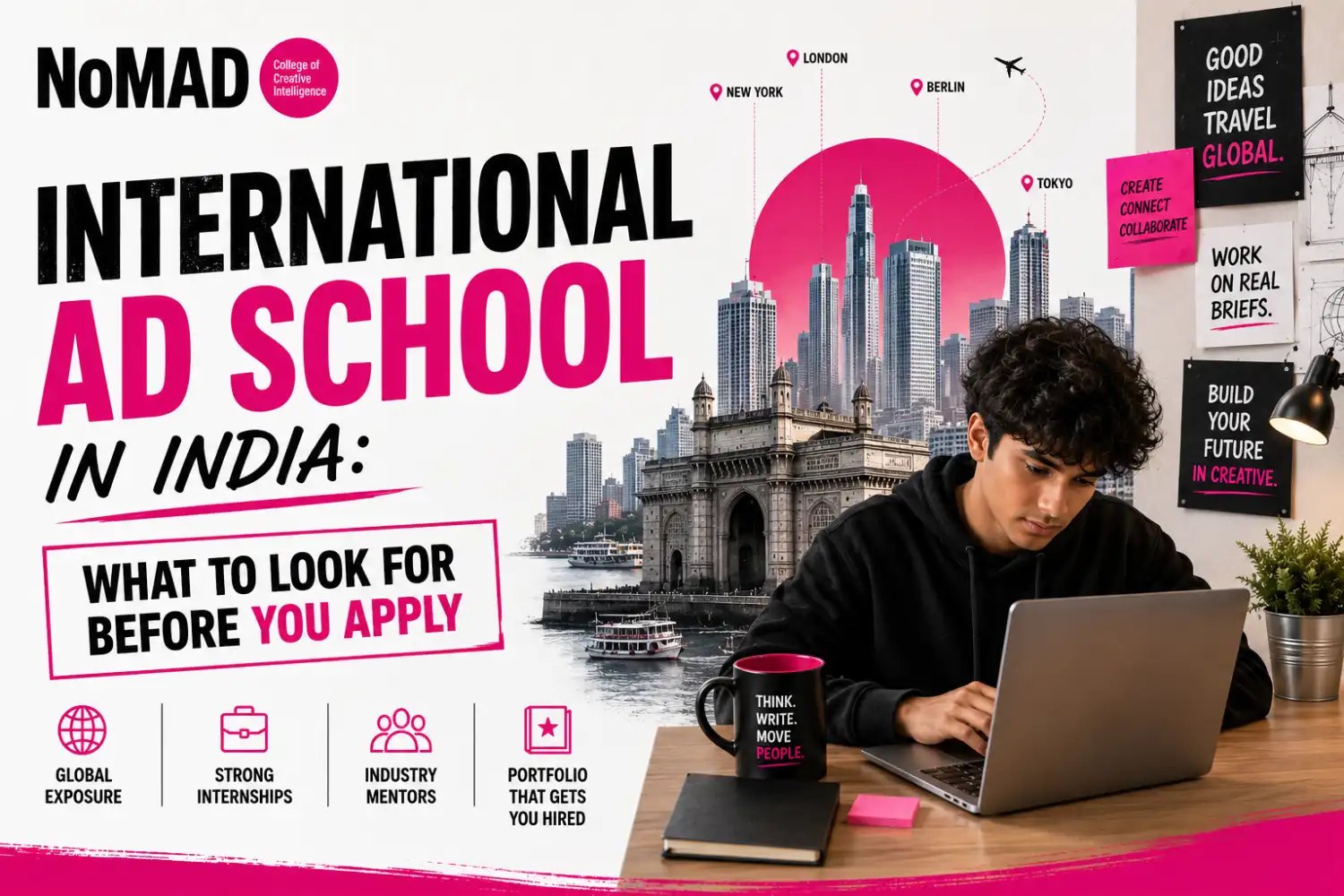
What gives the programme its international character is its connection to Miami Ad School and a wider network of global campuses. Through a global exchange structure, students can spend time at partner centres in cities such as New York, London, Berlin, and Tokyo. Faculty are drawn from working industry practitioners, the studios are designed for AI-first creative work, and internships sit within the later stages of the programme rather than as an afterthought.
None of this replaces your own diligence.
Conclusion: Choose on Evidence, Not on Confidence
Choosing an international ad school in India should never come down to which brochure sounds most confident. The students who choose well are the ones who ask better questions about accreditation, network access, placement structure, faculty, and the portfolio they will leave with. Advertising rewards proof of ability, so the school that helps you build that proof is the one worth your time and your fees.
If you want a creative education that is portfolio-first, industry-led, and connected to a global network, NoMAD College of Creative Intelligence is worth a closer look. Explore the programme, download the brochure, or book a counselling session to see whether it fits your ambitions.
FAQ Section
What is an international ad school in India?
It is an advertising school that offers structured global exposure, such as accredited international partnerships, study or internship opportunities abroad, and faculty with global agency experience, rather than only describing itself as international in marketing.
Is an international ad school in Mumbai better than one in Bangalore?
Neither city is automatically better. Mumbai offers proximity to the largest cluster of advertising agencies, while Bangalore offers a strong technology and startup base. The right choice depends on the programme structure and your career interest.
Do international ad schools in India offer global placements?
Some do, but the structure varies. Ask whether internships and placements are built into the programme, which agencies students join, and whether any opportunities are based abroad. Treat broad figures with caution unless the context is explained.
What qualifications do you need to apply to an advertising school in India?
Most programmes require completion of Class 12 for undergraduate entry. Postgraduate and diploma programmes usually accept graduates from any field. Many creative schools also assess a portfolio or a creative exercise alongside marks.
Is a portfolio more important than marks for advertising admissions?
In creative advertising education, the portfolio carries significant weight because recruiters hire on the strength of work. Strong marks help, but the ability to think, write, and design is usually the deciding factor.
How much does an international ad school in India cost?
Fees vary by programme, city, and duration. Always confirm current fees, scholarships, and payment timelines directly with the admissions team, since published figures can change between intakes.
Related Posts