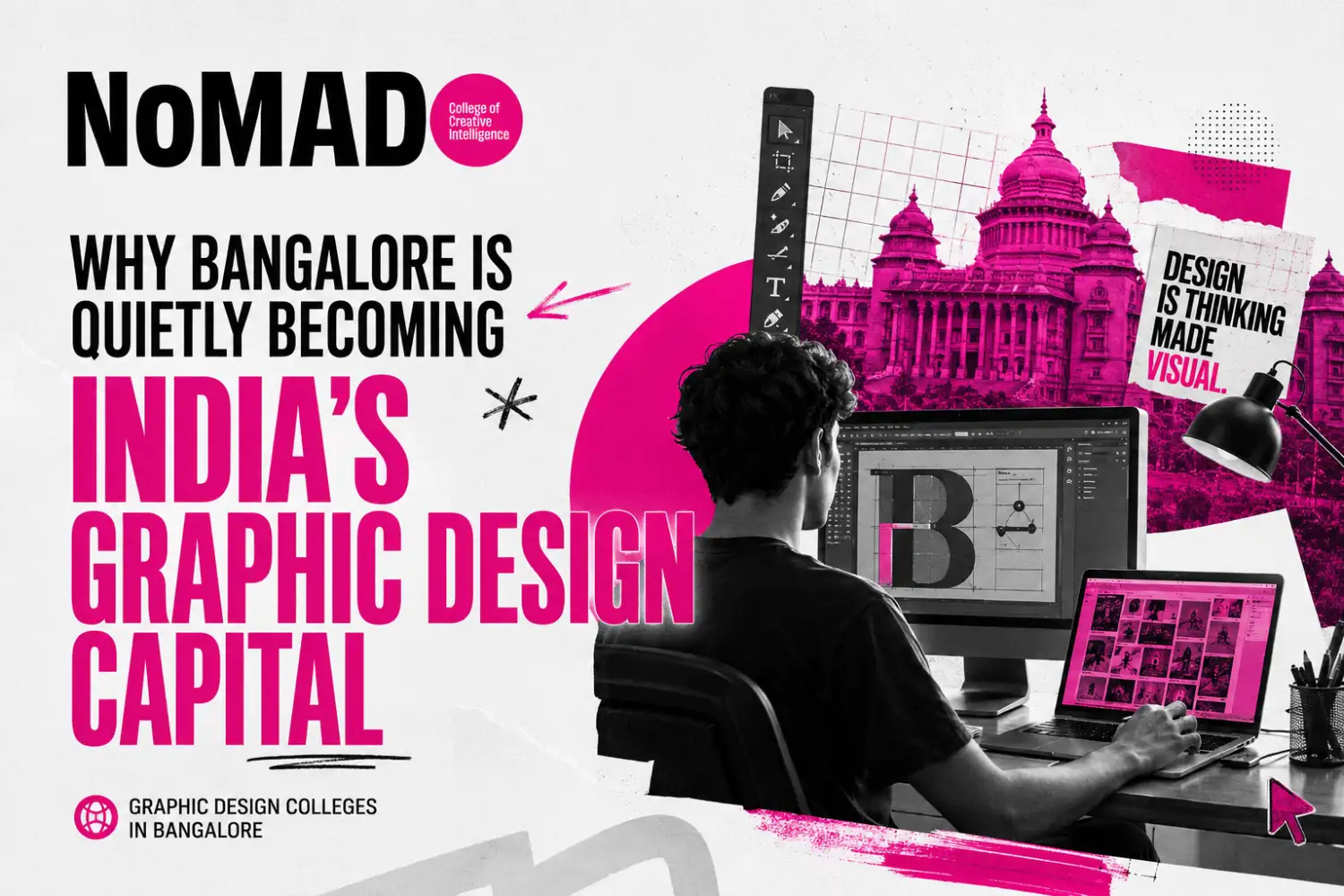
Bangalore has always been a home to technology, startups and engineering talent. However, India’s creative sector is valued at $30 billion, and amid this expansion, Bangalore is evolving into a major gaming and design hub. Hence, Creative careers like design, advertising, content, branding, and digital strategy are finding their footing in this city. Students searching for graphic design colleges in Bangalore are no longer a niche group; they represent a genuinely growing conversation about what creative education should look like in India right now.
This blog is for students and parents who want to think clearly about that question.
What Students Are Actually Looking for in Graphic Design Colleges in Bangalore
Before choosing a design college, the majority of students wonder what they will learn, if the programme is industry-ready, or if the course will open doors for them. A good programme should answer all these questions.
Bangalore’s creative education landscape has evolved. The city now hosts design schools, communication institutes, postgraduate diploma programmes, and integrated creative studios, all positioned differently and all serving different kinds of students. What they have in common is that they are responding to a market that now genuinely values visual communication, brand identity, digital content, and UI/UX thinking.
If you are exploring graphic design courses in Bangalore, you will find options ranging from short-term technical courses to full postgraduate diploma programmes. The difference between these formats matters enormously, not because of the certificate, but because of what actually happens during the programme.
Why Creative Education Needs More Than Classroom Theory
Graphic design colleges in Bangalore that solely prepare students for a theoretical understanding of graphic design may not open doors in the creative industry. They want to see how you think, what you have built, and whether you can solve a visual or communication problem independently.
This shift has unfolded gradually, however, reshaped the design landscape in a meaningful way. Design directors and creative heads across India increasingly look for a portfolio before they look at a transcript. This does not diminish academic rigour; it reshapes what rigour should mean in a creative context.
A student who has worked on live briefs, developed a typographic identity from scratch, navigated client feedback, and shipped real work into the world understands creative practice in a way that no amount of theory alone can teach.
The other dimension worth noting is the role of digital tools and AI-assisted workflows. Modern designers are expected to understand not just software but the logic behind generative tools, motion graphics, social-first content, digital campaigns, and interactive design. A programme that ignores these realities is not preparing students for the industry as it currently exists.
How NoMAD College of Creative Intelligence Approaches Creative Learning
NoMAD College of Creative Intelligence, based in Mumbai, approaches creative education with a curriculum that is portfolio-first and industry-led. The Post Graduate Diploma in Advertising and Media is structured across eight quarters, with a dedicated Graphic Design major alongside Art Direction and Copywriting tracks.
The curriculum is powered by Miami Ad School, a globally recognised creative education institution, and the undergraduate creative education journey at NoMAD is Mumbai University–backed. This means students receive both international pedagogical exposure and a recognised academic framework.
Across the eight quarters, Graphic Design students move through Foundation, Craft and Exploration, Applied Media and Experience, Concepting and Interaction, Digital and Culture, Brand and Self, and Portfolio and Launch phases. The final quarter is structured as a National and International Internship, placing students in real agencies on real briefs.
Subjects such as Design Influences, Type Journey, Vector Imaging, Visual Impact, Digital Studio, Pop Culture Engineering, Advanced Colour Correction, and Portfolio Development are more than just abstract additions; they reflect what working designers actually do.
The programme culminates in Portfolio Development and Self-Promotion modules, which means graduation is not a conclusion but a launchpad. Students leave with a body of work, not just a certificate.
Career Possibilities After Creative Education
Creative education opens more doors than most students initially expect. Graphic design training, when paired with strategic and conceptual thinking, can lead to a wide range of professional directions.
| Career Path | Core Skills Required |
| Graphic Designer / Visual Designer | Typography, layout, colour theory, digital tools |
| Art Director | Visual concept development, campaign thinking |
| Brand Designer | Identity systems, packaging, brand strategy |
| Social Media Designer | Platform-native content, motion basics, copy sense |
| UX/UI Designer | User flows, wireframing, visual hierarchy |
| Content Creator / Creative Lead | Multi-format storytelling, visual direction |
| Freelance Designer | Self-promotion, client management, portfolio |
| Creative Strategist | Insight, ideation, presentation skills |
The advertising and digital marketing sectors in India have grown significantly, with demand for skilled visual communicators particularly strong in metros, including Bangalore, Mumbai, and Delhi. Students from graphic design colleges in Bangalore, who graduate with strong portfolios and exposure to real agency work, are better placed to navigate these opportunities.
What Students Should Look for Before Choosing a Creative College
Whether you are evaluating graphic design colleges in Bangalore or programmes across India, there are specific things worth examining carefully before committing.
- Academic recognition: Is the qualification backed by a recognised university or institution? This matters for both employment and further studies.
- Portfolio outcomes: Can you see actual student work? Does it reflect the kind of practice you want to pursue?
- Faculty and mentors: Are the educators working professionals with active industry experience, or primarily academic in background?
- Internship structure: Is the internship a real placement with live project accountability, or is it a formality?
- AI and digital fluency: Does the curriculum address contemporary tools, workflows, and platforms, not just legacy software?
- Real client work: Are students working on actual briefs from actual brands during their studies?
- Global exposure: Does the programme connect students to international creative thinking, standards, and networks?
- Admission clarity: Is the process transparent about selection criteria, programme structure, and what is expected of you?
A diploma in graphic design in Bangalore, or anywhere else, is only as strong as the programme behind it. Ask specific questions. Look at student work before you look at marketing materials.
Is NoMAD the Right Fit for You?
| Attribute | Detail |
| Ideal Candidate Profile | Genuinely curious about creative practice, willing to be challenged, committed to building something real |
| What the Programme Offers | Space to explore ideas, learning through critique, live briefs, and a portfolio to graduate with |
| Student Traits That Thrive | Independent thinking, comfort with ambiguity, openness to feedback |
| Programme Structure | Designed to produce working creatives, not passive graduates |
| Who Should Consider It | Students seeking a rigorous, practice-led environment with tangible outcomes |
The pedagogical framework of NoMAD College of Creative Intelligence is deliberately intensive as it places a higher degree of responsibility on the students and, in return, offers a richer academic and professional return, which separates it from conventional educational institutions.
FAQs
1. What makes NoMAD College of Creative Intelligence different from other design institutes?
NoMAD’s curriculum is powered by Miami Ad School and structured as a portfolio-first, industry-led programme. Students work on real briefs, develop their portfolio across all quarters, and complete an internship in India or abroad. The focus is on preparing students for the creative industry, not for examinations alone.
2. Is NoMAD suitable for students without prior design experience?
Yes. The Foundation quarter is designed to build core creative and visual thinking skills from the ground up. Prior design experience is not a prerequisite, but genuine curiosity, visual interest, and a willingness to learn through practice are essential.
3. What careers can students pursue after studying at NoMAD?
Graduates are prepared for roles in graphic design, art direction, brand design, social media content, advertising, digital marketing, UI/UX, creative strategy, and freelancing. The portfolio built during the programme is the primary professional asset upon graduation.
4. Does portfolio matter in creative careers?
Significantly. Across advertising agencies, design studios, in-house brand teams, and digital marketing companies, a portfolio is typically the first thing a hiring manager or creative director looks at. It demonstrates applied skill, taste, and problem-solving ability in ways that a transcript cannot.
5. Does NoMAD incorporate AI and new creative tools into its curriculum?
The programme includes modules on digital studio practice, digital campaigns, motion, and emerging creative platforms. Students are introduced to tools and workflows that reflect contemporary industry practice, including the evolving role of AI in visual and communication design.
Conclusion
Bangalore’s emergence as a creative city is not incidental. It reflects broader shifts in how India’s economy values design, communication, and visual intelligence. For students searching for graphic design colleges in Bangalore and across India, the most important question is not which institution has the most impressive name; it is which programme will give you the skills, the portfolio, and the professional exposure to build a genuine creative career.
Portfolio-first, industry-connected, globally informed creative education is not a luxury offering. It is what the industry now expects from the people entering it.
If you are serious about a creative future, explore what NoMAD College of Creative Intelligence offers. Visit the campus, speak with the admissions team, and look at the student work. That conversation is the most useful starting point.
Source
Related Posts