For a large number of Indian families, the interval between the Class 12 results and the start of higher education is defined by competing counsel. One relative advocates engineering; a neighbour cites a successful CLAT attempt; a coaching centre presents a familiar set of courses as the only responsible route. Beneath this well-meaning advice lies a question that is seldom examined directly: whether a conventional degree or a creative field such as Brand Communication and Design is better matched to how a particular student actually thinks and works.
There is no inherent conflict between a secure career and a creative one. Traditional programmes in engineering, management and law continue to serve students well. At the same time, fields such as Brand Communication, Advertising and Communication Design have matured into viable long-term professions within a rapidly growing creative economy. Aptitude, not social pressure, should determine the decision.
Why Did Engineering, BBA and Law Become the Default Choice in India?
For nearly two generations, three courses carried the label of “secure”. Engineering promised a job in IT. Commerce and a BBA promised a corporate desk. Law promised respect and a stable practice. Parents who grew up with financial uncertainty naturally pushed their children towards paths that felt tested and repeatable.
None of that was wrong for its time. These fields built real careers for lakhs of families. The problem is simpler than it sounds: a choice that made sense in 2005 is now being applied automatically in 2026, often without checking whether the student actually enjoys the subject or whether the job market still rewards it the same way. A student who doodles through physics class is quietly pushed into an engineering seat because it feels safer than the alternative, but nobody in the family understands.
Safe is good. Safe by default, without thinking, is where the trouble starts.
Why Is the Career Market Changing After 12th?
Two things have shifted at the same time. First, automation and artificial intelligence are reshaping routine work across sectors, including parts of coding and back-office roles that once looked untouchable. Second, and more encouraging, an entire creative economy has moved from the margins to the mainstream of national policy.
In the Union Budget 2026-27, presented in Parliament on 1 February 2026, Finance Minister Nirmala Sitharaman placed India’s “Orange Economy” firmly on the agenda. The Orange Economy, also called the creative economy, is the part of the economy driven by creativity, culture and intellectual property. It covers advertising, design, film and television, animation, gaming, digital content, music and other creative services. In the same speech, the Finance Minister noted that India’s Animation, Visual Effects, Gaming and Comics (AVGC) sector is projected to require nearly two million professionals by 2030, and announced support for setting up creative content labs across schools and colleges.
The significance of this should not be understated. It is a matter not of institutional advocacy but of national economic policy, in which creative skills are identified as a source of employment over the next ten years. A shortfall of this magnitude in trained personnel points directly to the prospects available to students entering the field today.
What Are Creative Careers Like Brand Communication and Design, Really?
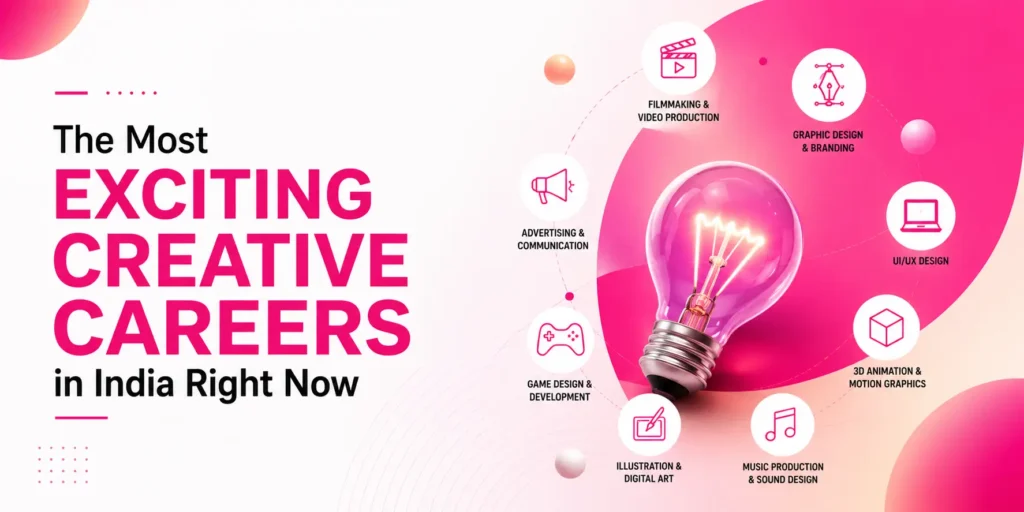
There is a common misunderstanding that “creative course” means only drawing or making posters. Brand Communication and Communication Design are far broader than that. At their core, they are about solving problems with ideas and then expressing those ideas so clearly that people notice, feel something and act.
A brand communication professional works on how a company speaks, looks and behaves across every touchpoint, from a launch campaign to the tone of an app notification. A communication designer shapes how information and identity are visualised, through typography, branding, motion, digital design and user experience. These are thinking jobs before they are making jobs. The craft matters, but the strategy behind it matters more, which is exactly why these roles are harder to automate than people assume.
Traditional Courses vs Creative Courses: An Honest Comparison
No single field is better for everyone. What matters is fit. The table below compares the traditional trio with new-age creative programmes on the factors students and parents actually worry about.
| Factor | Engineering / BBA / Law | Brand Communication / Communication Design / Visual Communication / Media |
| Core strength rewarded | Analytical, procedural, rule-based thinking | Idea generation, visual and verbal expression, strategy |
| Learning style | Largely theory and examination driven | Project and portfolio driven, hands-on |
| Entry into the field | Standardised entrance exams (JEE, CAT, CLAT and similar) | Aptitude, a portfolio and a strong interview |
| What you show an employer | Marks, degree, internships | A portfolio of real work you can point to |
| Automation pressure | Rising in routine roles | Lower for original, strategic creative work |
| Career ceiling | Well-mapped, competitive | Wide and still expanding with the creative economy |
| Best suited for | Students who enjoy structure and clear rules | Students who enjoy ideas, visuals, culture and communication |
The honest takeaway: if you genuinely enjoy the logic of engineering, the numbers of business or the reasoning of law, those courses will serve you well. If you find yourself more alive when you are shaping an idea, noticing good design or thinking about why a certain ad worked, forcing yourself into a traditional seat is the actual risk, not the creative path.
What Skills Do You Actually Build in a Creative Programme?
A well-designed advertising and communication design course is not four years of soft subjects. Students typically build a stack of skills that employers pay for, including typography and layout, branding and brand strategy, storytelling and copy, digital and social campaign design, consumer and cultural psychology, user experience thinking, motion graphics, media planning and, increasingly, AI-integrated creative workflows.
Notice the pattern. These are practical, portfolio-producing skills. You do not just learn about a campaign, you make one. That is why the strongest creative programmes are built around real briefs rather than only textbooks.
What Careers Open Up After Brand Communication, Advertising and Design?
A creative education does not lead to a single job title. It opens a spread of roles across agencies, brands, media houses and start-ups. Common pathways include brand strategist, art director, graphic and communication designer, creative director over time, content creator, communication specialist, media planner, advertising executive and digital marketer.
The useful thing about these careers is that they travel. A strong portfolio is understood in Mumbai, Bengaluru, Dubai, London or Singapore without needing translation. Creative hubs like Mumbai and Bengaluru, where much of India’s agency and start-up work sits, make it easier to intern early and build a network while you study.
Is a Creative Career Stable, Respectable and Well Paying?
On stability, a career may be considered secure when the underlying skill is both in demand and difficult to replace. A trained creative professional with a substantial portfolio meets precisely this description, and the national Budget itself now indicates a significant shortage of talent across the creative industries. On income, creative careers, like most professions, reward competence and experience. Entry-level remuneration varies by role and location, and it would be misleading to state fixed figures, yet senior positions in creative and strategic functions in India are well remunerated and in limited supply. On respectability, students entering these fields today are not compromising. They are choosing a sector in which the government, global brands and the largest technology platforms are all actively investing.
The earlier apprehension held that a creative course led nowhere. The present evidence suggests the reverse. What truly leads nowhere is a poorly matched degree with which a student never meaningfully engages.
Where Does NoMAD College Fit In?
If a portfolio-led creative direction appears suitable, the question that follows is where it may be studied to a high standard. Here, it is worth distinguishing institutions designed specifically for this form of learning from general colleges that offer a creative elective as an addition to an otherwise conventional programme.
NoMAD College of Creative Intelligence is a portfolio-first creative institution, with a campus in the Upper BKC area of Mumbai and a presence in Bangalore, established on the Miami Ad School legacy in India. Its emphasis is clear: practical instruction in preference to dated theory, engagement with real client projects, and mentorship from practising creative directors, strategists and designers rather than classroom teachers alone.
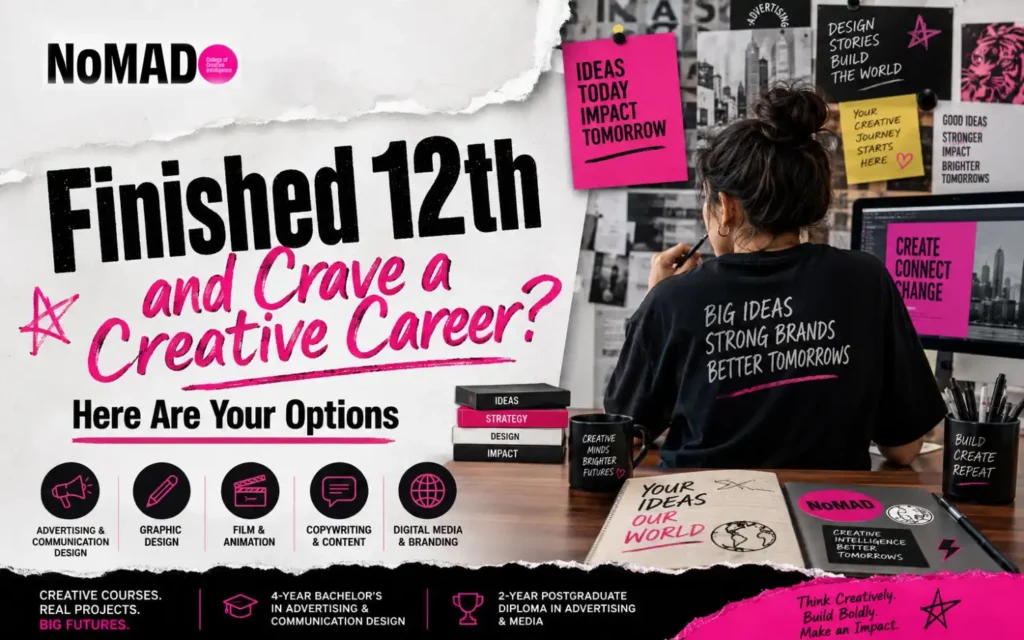
The college offers a Bachelor’s in Advertising and Communication Design for students after Class 12, and a Post Graduate Diploma in Advertising and Media for graduates seeking to enter the field. Its teaching spans the areas that carry weight in the industry at present, from branding, typography and storytelling to digital campaigns, media planning, UX and AI-integrated creative work.
NoMAD emphasises international internship exposure and a global creative network, and its declared aim is to help students develop a strong, employability-focused portfolio rather than to promise employment. That distinction deserves respect. No reputable institution guarantees placements; a good one provides the projects, mentors and industry exposure through which they may be earned.
So, What Should You Actually Choose After 12th?
Make the decision on four honest questions, not under pressure.
First, aptitude. What kind of thinking genuinely energises you, structured problem-solving or idea-and-expression work? Second, work style. Do you prefer clear rules and known answers, or open briefs where you create the answer? Third, portfolio potential. Are you excited by the idea of building a body of real work you can show, rather than only earning marks? Fourth, industry direction. Which fields are actually hiring and growing over the next ten years?
If your answers point towards structure and rules, a traditional course is a sound, respectable choice, and you should pursue it with confidence. If they point towards ideas, culture and communication, then a creative career like Brand Communication and Design is not a gamble anymore. It is one of the more forward-looking decisions you can make after 12th. Choose the path that fits the way your mind actually works, and you will outperform anyone who simply follows the crowd.
FAQ Section
Is a creative career after 12th a safe choice compared to engineering or law?
A creative career is as safe as the skill behind it. Fields like Brand Communication and Design are now backed by India’s growing creative economy, which the Union Budget 2026-27 flagged as a major source of future jobs. The key is a strong portfolio and real industry exposure. For a student who genuinely enjoys ideas and design, a creative course is often safer than a mismatched traditional degree that they never engage with fully.
What is the difference between a BBA and a design course after 12th?
A BBA trains you in business management, finance and operations through a largely theory and examination-based structure. A design or communication design course trains you to solve problems visually and strategically, and is built around projects and a portfolio. BBA suits students who enjoy structured business thinking. A design course suits students energised by ideas, visuals and communication. Neither is superior; the right pick depends on your aptitude and how you prefer to work.
What career options come after a Brand Communication or Communication Design course?
These programmes open several pathways rather than one fixed job. Graduates commonly move into roles such as brand strategist, art director, graphic and communication designer, content creator, media planner, advertising executive and digital marketer, and progress towards creative director over time. The work spans agencies, brands, media houses and start-ups. Because a portfolio is understood everywhere, these careers also travel well across Indian creative hubs and international markets.
Is the Orange Economy a real career opportunity or just a buzzword?
It is a real and officially recognised opportunity. In the Union Budget 2026-27, the Finance Minister highlighted the Orange, or creative, economy and noted that the AVGC sector alone is projected to require nearly two million professionals by 2030. That points to a genuine shortage of trained people across advertising, design, animation, gaming and digital content, which is good news for students entering these fields with the right skills now.
Will artificial intelligence replace creative and design jobs?
AI is changing how creative work is produced, but it is not replacing original thinking. Tools can generate drafts and speed up execution, yet strategy, cultural insight, taste and the judgment of what idea is right still come from people. The professionals most in demand are those who use AI as part of their workflow while owning the thinking. That is why modern creative programmes now teach AI-integrated creative skills rather than avoiding the topic.
How is a portfolio-first education different from a normal degree?
A traditional degree is measured largely by marks and examinations. A portfolio-first education is measured by the real work you produce along the way. Instead of only studying campaigns, you build them, so you graduate with evidence that an employer can see. In creative industries, a strong portfolio often matters more than the certificate itself, which is why portfolio-led learning is a practical advantage when you start applying for roles or internships.
Does NoMAD College guarantee a job after the course?
No responsible institution guarantees jobs, and NoMAD does not frame it that way. Its focus is on building a strong, employability-oriented portfolio through real client projects, industry mentorship and internship exposure, so students are prepared to compete for roles on merit. A guarantee would be a warning sign anywhere. What a good college offers is the projects, mentors and industry connections that improve your chances, and NoMAD positions itself around exactly that.
Should I choose a creative course if my parents prefer a traditional one?
Start with an honest conversation rather than a rebellion. Show your parents what the field actually involves, the range of careers it leads to, and the official recognition the creative economy now has. Their concern is usually about stability, and that concern can be answered with facts rather than emotion. If your aptitude clearly points towards ideas and design, a creative career is a considered choice, not a risky one, and most parents respond well to a plan they can understand.
Related Posts