An interest in consumer choice rarely arrives as a decision. It tends to surface in small observations, in the recognition that one advertisement settles into memory while another is forgotten within moments. Such observations suggest a field worth examining, yet a career in brand strategy seldom presents itself plainly as a profession. It borrows from marketing, from research, and from design, and that combination leaves many students unsure of where the work properly sits. The uncertainty that follows can make a sound career appear unsettled.
This guide is written to resolve that uncertainty. It sets out the responsibilities of a brand strategist, identifies the skills the role requires, distinguishes strategy from management, and describes a practical path into the profession in India. Throughout, the emphasis falls on clarity rather than terminology, accompanied by a candid account of the daily work and the portfolio that creates genuine opportunity. By the end, you will know whether the field suits the way you think.
What does a career in brand strategy look like?
A career in brand strategy is to study people and markets, then define what a brand should stand for and how it should speak. The strategist turns research and insight into a clear direction that creative and marketing teams can act on.
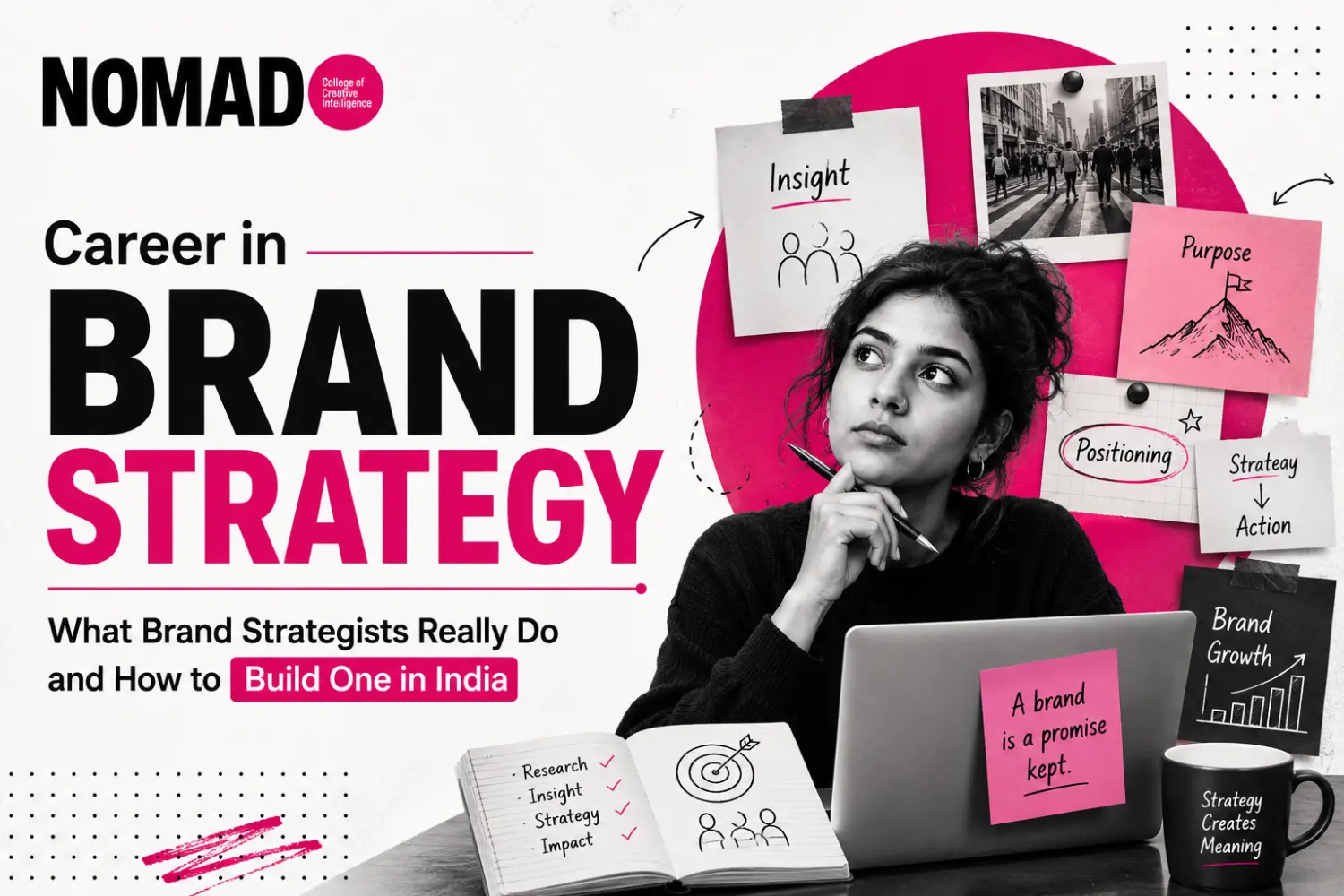
A brand strategist defines what a brand stands for and how it should behave across every touchpoint. The role combines consumer research, competitor analysis, positioning, and messaging into a clear direction that guides creative, marketing, and product teams. In short, the strategist decides what a brand should mean to people.
In practice, the work moves between curiosity and clarity. A strategist might spend the morning reading consumer interviews, the afternoon studying a competitor position, and the evening shaping a single sentence that captures what a brand wants to mean. The output is rarely the advertisement itself. It is the thinking that makes the advertisement worth making.
Strategists work across agencies, brand consultancies, in-house teams, and startups. On any project, they may define a brand purpose, map its audience, sharpen its tone, or guide a launch. The common thread is direction. When a brand feels confused, the strategist is usually the person who makes it coherent again.
Brand Strategist vs Brand Manager: What Is the Difference?
This is one of the most common doubts students raise, and the answer shapes the path you prepare for. The brand strategist vs brand manager question is less about seniority and more about focus. A strategist sets the direction of a brand. A manager runs the brand day to day and is accountable for its commercial results.
| Dimension | Brand Strategist | Brand Manager |
| Core focus | Long-term meaning and positioning | Day-to-day growth and performance |
| Main question | What should this brand stand for? | How do we hit this brand target? |
| Typical output | Positioning, brand architecture, messaging | Marketing plans, campaigns, and profit tracking |
| Works most with | Research, planning and creative teams | Sales, marketing, supply chain, finance |
| Mindset | Conceptual and exploratory | Operational and commercial |
| Common entry point | Agencies, consultancies, planning roles | Brand or marketing teams inside companies |
Neither role is superior. Many strong marketers move between the two over a career. What matters is knowing which kind of thinking you enjoy, because that decides where you should build your first skills.
Skills Required for Brand Strategy
The skills required for brand strategy are a mix of analytical and creative habits. You do not need all of them on day one, but you do need to start practising them early.
• Research: reading people, culture, and data without rushing to a conclusion.
• Analysis: spotting the pattern others miss inside a messy brief.
• Writing: explaining a complex idea in a sentence that a client remembers.
• Visual literacy: understanding how design carries meaning, even if you do not design yourself.
• Persuasion: presenting an idea so that a room believes in it.
• Business curiosity: caring about how brands actually make money.
Most of these cannot be learned from theory alone. They grow through real briefs, feedback, and repetition. Programs built around live projects and industry mentorship, such as the portfolio-first approach at NoMAD, exist precisely so students can practise this work before they enter the industry.
How to Build a Career in Brand Strategy in India
Demand for this kind of thinking is rising. According to WARC and its Voice of the Marketer survey, a majority of marketers planning to raise budgets in 2025 intended to spend more on brand-building, and not only on short-term performance. As Indian brands invest more in meaning rather than reach alone, the people who can define that meaning become valuable.
So, how do you build a career in brand strategy in India when you are starting from Class 12 or an undergraduate seat? The roadmap below breaks it into stages.
| Brand Strategist Career Roadmap (India) | What to do |
| Stage 1: Build foundations | Learn the basics of marketing, design, and consumer behaviour. Understand how brands and businesses connect. |
| Stage 2: Learn the craft on real briefs | Practise positioning, research, and frameworks on live projects, not hypothetical ones. |
| Stage 3: Build a portfolio | Document two or three strategy projects that show your reasoning from problem to recommendation. |
| Stage 4: Gain real experience | Use internships at agencies, brands, or startups to test your thinking in a working team. |
| Stage 5: Enter and grow | Start as a junior strategist or planner, then deepen your range across categories and clients. |
You do not have to follow this in a straight line. Some students intern early, others build a portfolio first. The order matters less than the proof you collect along the way.
If you are serious about turning a creative interest into a career strategy, explore NoMAD’s program and download the brochure to see how the curriculum is structured.
How to Build a Brand Strategy Portfolio
If there is one question that decides your first job, it is this: brand strategy portfolio, how to build it when you have no formal experience yet. The honest answer is that you build it from real problems, not invented ones.
A strong starter portfolio usually includes two or three projects that show your thinking, not just your output. For each one, present the problem, your research, the insight you found, the direction you recommended, and the reason behind it. Hiring teams care less about polish and more about whether your logic holds.
This is where the learning environment matters. NoMAD offers:
- A Mumbai University-backed undergraduate degree, offering academic recognition alongside creative training
- A formal connection with Miami Ad School and access to a wider global creative network
- Live briefs and real client projects that build practical, work-ready experience
- Industry-first faculty and mentors who teach from current professional practice
- Internship exposure across both India and international markets
- A portfolio-first model by design, so you graduate with strategy work you can actually show, not a transcript alone
The model is portfolio-first by design, which means you graduate with strategy work you can actually show, rather than a transcript alone.
Is It the Right Path for You?
Most students do not struggle because the brand strategy is unclear. They struggle because no one explains the work honestly. Now you have a clearer picture. A career in brand strategy rewards people who are curious about why humans choose what they choose, and disciplined enough to turn that curiosity into direction.
It is a field that values thinking, proof, and a portfolio over marks alone. If that sounds like you, the next step is simple. Build real work, ask for honest feedback, and study where the work is treated as work.
If you want a creative education built around exactly that, speak to the NoMAD admissions team to understand whether the program fits your goals.
FAQ
What does a brand strategist actually do?
A brand strategist defines what a brand stands for and how it communicates, turning research and insight into a clear direction that creative and marketing teams can act on.
Is a brand strategy a good career in India?
Yes. As Indian brands invest more in long-term brand-building alongside performance marketing, demand for people who can shape brand direction continues to grow.
What is the difference between a brand strategist and a brand manager?
A strategist sets the long-term direction and positioning of a brand. A brand manager runs the brand day to day and is accountable for its commercial results.
What skills are required for a career in brand strategy?
Research, analytical thinking, clear writing, visual literacy, persuasion, and genuine curiosity about how brands and markets work.
How do I build a brand strategy portfolio with no experience?
Solve real problems. Show two or three projects where you present the brief, your research, the insight, and the direction you recommended, with your reasoning visible throughout.
Do I need a degree to become a brand strategist?
A relevant degree helps, but a strong portfolio and real project experience often matter more to hiring teams across creative industries.
Where do brand strategists work?
In advertising agencies, brand consultancies, in-house marketing teams, startups, and increasingly in digital and content-led organisations.
Related Posts