For many students researching NoMAD College placement outcomes, the underlying concern holds immense practical relevance. For example, does completing a creative programme translate into consistent, paid employment, or does graduation simply mark the end of structured support? It is a legitimate concern. Creative careers do not follow the linear progression associated with fields such as engineering or commerce, and this ambiguity is often a source of anxiety for both students and their families.
What is frequently overlooked, however, is that hiring within advertising, design, and digital media operates on a fundamentally different set of criteria. Recruiters and agencies do not evaluate candidates primarily on academic performance. They evaluate portfolios, creative instinct, and demonstrated ability.
This blog outlines what the placement process looks like at a portfolio-driven creative institution, identifies the industries and companies that actively recruit creative talent, and explains how the transition from education to professional practice is structured at NoMAD College.
What does NoMAD College placement actually look like?
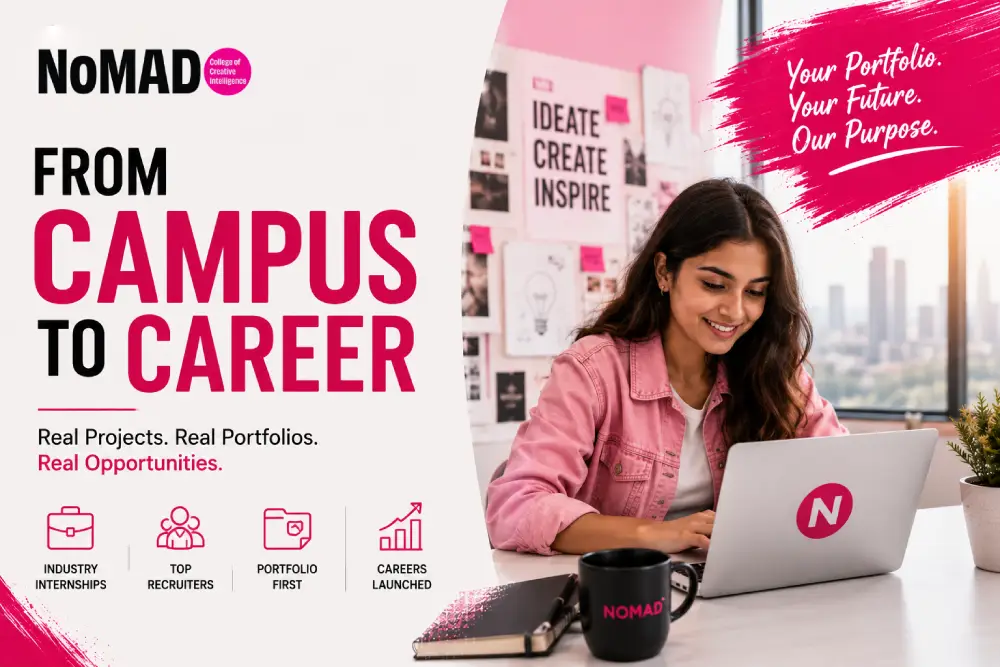
NoMAD College placement is built around a portfolio-first model rather than a single campus recruitment week. Students work on live client briefs from the early stages of the program, complete structured internships, and graduate with a body of work that agencies and brands can evaluate directly. NoMAD reports alumni outcomes at companies including Netflix, Ogilvy, and Salesforce.
Placement here is the outcome of strong work, not a separate event. The portfolio you build across the program is the thing that opens the door.
Why does a portfolio matter more than marks in creative hiring?
In creative industries, your portfolio is your real CV. A creative director hiring a junior art director or copywriter wants to see how you think and what you can make. They open your work, look at the craft, and decide within minutes. A transcript rarely enters that conversation.
This is why a portfolio-first approach changes the placement equation. When you have spent the program solving real briefs, you do not arrive at an interview hoping to be taught on the job. You arrive with proof. NoMAD frames this plainly in its own materials: the work is what gets you in. That is also why the college describes its outcome as launching careers rather than simply placing students.
Who are NoMAD College’s top recruiters?
NoMAD connects students to leading Indian and global agencies, technology companies, and creative studios. Its placement brochure lists exposure to and hiring at some of the most recognised names in the industry. The table below groups the companies NoMAD references so you can see the breadth of where creative talent can land.
| Sector | Companies NoMAD references |
| Advertising and creative agencies | Ogilvy, Leo Burnett, DDB, McCann, BBDO, Wieden+Kennedy, Mother, Dentsu, WPP, Omnicom (OMG) |
| Technology and digital platforms | Google, Meta, Apple, TikTok, WhatsApp, Spotify |
| Media, entertainment and brands | Netflix, Disney, Coca-Cola, Pepsi, Amazon |
| Consulting and services | Accenture, Salesforce |
Two points are worth keeping honest here. First, this list reflects the wider creative network NoMAD is connected to, including the Miami Ad School community. Second, exposure to a network is not the same as a job offer. What converts the connection into a role is the strength of your portfolio.
How does the internship-to-placement pipeline work?
NoMAD treats internships as the bridge between learning and hiring, not as an afterthought. In the four-year Bachelor’s Program in Advertising and Communication Design, the final year is structured around national and international internships, with global exposure built into the journey. The college also runs a structured internship-to-placement pipeline, where agency partners can hire directly from the school.
This matters because most first creative jobs come through proximity. You intern, you contribute, and the team already knows your work when a role opens.
What does NoMAD college placement assistance include?
NoMAD college placement assistance is less about a one-time placement drive and more about ongoing career support. Based on the college’s stated approach, that support includes:
• One-on-one portfolio reviews so your work is interview-ready, not just complete.
• Mock interviews to prepare you for how creative teams actually assess candidates.
• Direct introductions to hiring managers across agencies, studios, and brands.
• Access to a global alumni referral network spanning the Miami Ad School community.
• Mentorship from working professionals who bring current briefs and live industry relationships into the classroom.
If you have ever wondered why some graduates seem to walk into roles while others struggle, this is usually the difference. Assistance that starts in year one beats assistance that starts at graduation.
Which creative roles can you realistically target?
Creative education opens more doors than most people expect. After a portfolio-first program, graduates commonly move toward roles such as art director, copywriter, brand strategist, digital marketing creative, experience and UX designer, content creator, and, in time, creative leadership. Some choose a different route entirely and build their own studios or freelance practices. The point is that the skill set is portable. A strong portfolio travels across agencies, brands, startups, and platforms.
Where NoMAD College Placement Stands Against These Criteria
Assessed against the nine criteria above, NoMAD College is structured around the conditions that the creative industry hiring actually requires. Live client briefs are introduced from the first year rather than reserved for final-year projects. Portfolio development is treated as an ongoing academic process, with structured reviews built into the calendar rather than offered as supplementary support. The internship pipeline is defined and college-facilitated, with the final year of the Bachelor’s programme in Advertising and Communication Design dedicated to national and international placements. Faculty are drawn from active professional practice, which means the briefs, feedback, and industry relationships students encounter are current rather than historical.
The result is a creative-first learning environment across Mumbai and Bangalore, supported by AI-first studios, personalised mentorship, and a global alumni network through Miami Ad School alongside a Mumbai University-backed degree that carries formal academic recognition.
For a student who is serious about turning a creative interest into a sustainable career, the criteria above are the right basis for any college decision.
If NoMAD’s approach to placement aligns with what you are looking for, the practical next step is a direct conversation. Speak with the NoMAD admissions team, review the current programme structure, or download the brochure to confirm eligibility, intake dates, and available courses.
Final Thoughts
The fear is not really about a creative course. It is about whether creativity can become a stable, respectable career. The honest answer is that it can, but the path runs through work, not through a degree alone. NoMAD College placement is structured around that truth. You build a portfolio, you intern with intent, and you graduate with proof that hiring teams can actually evaluate.
For a Class 12 student weighing options, or a parent weighing reassurance, that distinction is the whole decision. A creative career rewards people who can think, build, and earn, and the colleges that prepare you for it are the ones that put real work at the centre.
Ready to see if it fits? Explore the program, book a counselling session, or visit the campus to talk through your goals with the NoMAD team.
FAQ Section
Does NoMAD College offer placement?
NoMAD focuses on a portfolio-first approach and runs an internship-to-placement pipeline with career support such as portfolio reviews, mock interviews, and introductions to hiring managers. It positions placement as the result of strong work rather than a single recruitment event.
Which companies recruit creative talent linked to NoMAD?
NoMAD references exposure to and hiring at agencies and brands, including Ogilvy, Leo Burnett, DDB, McCann, Netflix, Google, Meta, and Salesforce, partly through the Miami Ad School network. The exact, current recruiter list should be confirmed with the college.
Is placement guaranteed at NoMAD College?
NoMAD describes guaranteed internships within its program structure. For full-time placement, the honest framing is that the portfolio and internships you build strongly improve your career readiness rather than constituting an automatic job guarantee.
How does NoMAD college placement assistance work?
Assistance is ongoing rather than last-minute. It includes one-on-one portfolio reviews, mock interviews, direct introductions to hiring managers, mentorship from working professionals, and access to a global alumni referral network.
What roles can I target after NoMAD?
Common paths include art director, copywriter, brand strategist, digital marketing creative, UX or experience designer, content creator, and creative leadership roles, along with freelance and startup routes.
Does NoMAD offer international exposure for placements?
Yes. NoMAD includes global exposure through the Miami Ad School network and international internship options, particularly in the later stages of the program.
What is the eligibility to apply to NoMAD?
Students who have completed Grade 12 or higher can apply, along with graduates from any field and transfer students from related creative programs. Confirm the current eligibility and application steps with admissions.
Related Posts