You’ve invested countless hours learning from creators, writers, and analysts online. You understand the landscape. But without systematic foundations, the application remains fragmented. A structured media studies course transforms scattered knowledge into professional methodology.
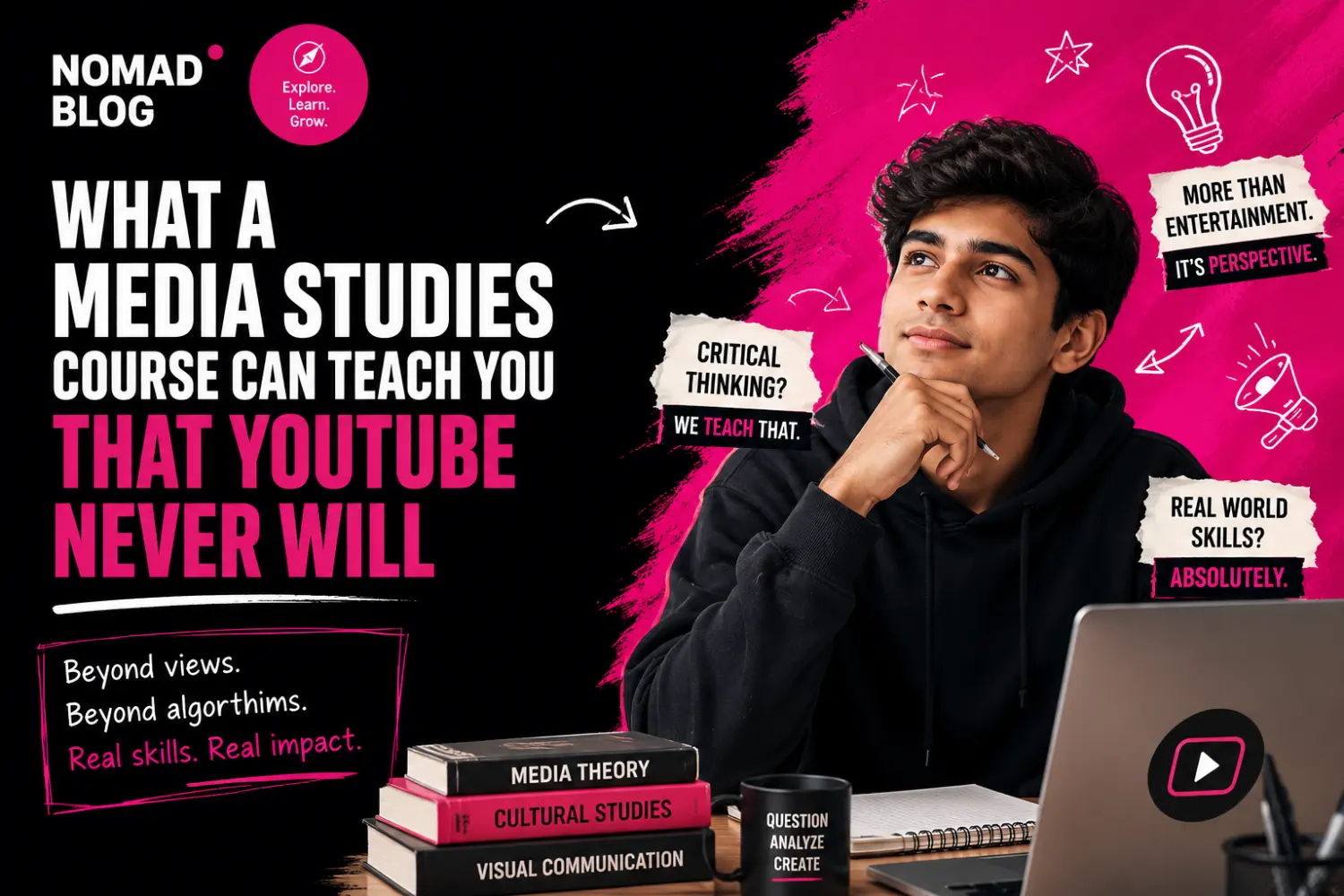
The world of media and creative education has changed. Students today assume they can learn anything online. And they are partially right. But a structured media course teaches something YouTube cannot: how to think, build, and earn as a creative professional in a real industry.
This blog explores what a formal course actually teaches, and why self-learning, no matter how comprehensive, cannot replicate the experience.
A media course teaches industry workflow, real client work, peer collaboration, faculty mentorship, portfolio development under professional standards, and exposure to live creative briefs. These elements develop judgment, speed, and credibility that online tutorials alone cannot build.
How a media studies course Bridges The Gap Between Watching and working
YouTube teaches skills. It does not teach judgment.
A tutorial shows you how to use a design tool. A media course teaches you when to use it, why the client rejected your first direction, and how to recover when a deadline shifts.
For example, if a student learns motion graphics from a YouTube channel. They understand keyframes, timing, and easing curves. They have completed five motion projects. Inside an agency internship, a student encounters a different hierarchy where narrative comes first, and motion comes second. In the hierarchy of craft, narrative sits above technique.
A formal media course embeds this understanding from day one. Students work on live client briefs in year one. They pitch to real brands in year two. They experience rejection, feedback loops, and creative problem-solving, the actual texture of media work.
This is what YouTube cannot teach.
Real Client Projects vs. Portfolio Projects
Every online course asks you to build a portfolio.
But there is a critical difference between a project you design for a portfolio and a project a real client has paid for.
In a formal media studies program, students do not simply create hypothetical work. They solve actual business problems. A brand really does need its advertising concept. A startup really does need its communication strategy. The stakes feel different because they are different.
This exposure changes how students think. They learn to ask questions before designing. They learn to measure impact, not just aesthetics. They learn that the best idea is often the simplest one.
A media studies undergraduate or postgraduate course structures this experience across semesters. Year one might focus on foundational design thinking. Year two introduces strategy and audience insight. Years three and four are dominated by live projects and internships. This progression cannot be replicated by watching tutorials in isolation.
Mentorship From Industry Practitioners
A media course connects you with faculty who are active practitioners in advertising, design, branding, and digital strategy. These are professionals currently working at agencies, brands, and studios. They have judged real campaigns. They have pitched to real clients. They know what works and what fails.
More importantly, they get to know you. They see your work across multiple projects. They understand your strengths, your blind spots, and your potential. They mentor you toward a career, not toward completing a course.
This mentorship accelerates growth in ways online courses cannot.
Learning How Creative Professionals Actually Think
A media course teaches creative thinking differently from YouTube.
Online, you learn techniques. In a classroom with a real brief, you learn workflow.
Here is the difference: A YouTube tutorial might show how to brainstorm ideas using mood boards. A media course shows what happens when you brainstorm with your team, a creative director challenges your assumption, a client’s feedback requires you to restart, and you have three days instead of three weeks.
This teaches time management, resilience, communication, and judgment under pressure, skills that define professional creatives but are nearly invisible in online content.
Additionally, a formal course teaches you how different disciplines collaborate. A copywriter sits next to a designer. A strategist reviews a visual concept. A media planner explains budget constraints. This cross-functional exposure builds the soft skills that employers actually value.
A Structured Path to Industry Readiness
Self-learning is chaotic by nature. You decide what to learn next. You follow your interests. You may develop deep expertise in one area and neglect another.
A media studies curriculum is intentionally designed to build a complete professional. It does not leave gaps.
Consider the Bachelor’s Program in Advertising and Communication Design offered by institutions like NoMAD College of Creative Intelligence. Year one builds visual and conceptual foundations. Year two introduces strategy and brand thinking. Year three emphasises applied learning through real projects. Year four is dedicated to internships at global agencies.
This progression ensures you do not graduate as an expert designer with weak strategy skills, or a good thinker with poor execution ability. You graduate industry-ready across multiple dimensions.
Online learning cannot guarantee this breadth. You curate your own path, and curation has blind spots.
Global Exposure and Cross-Cultural Learning
Formal media studies programs by NoMAD College of Creative Intelligence offer global exchange and international internship opportunities.
This is nearly impossible to gain from YouTube.
A media studies postgraduate program might place you in New York at a creative agency, London at a design studio, or Singapore at a digital marketing firm. You live abroad. You work with international teams. You see how media and advertising differ across markets.
This exposure fundamentally changes how you think about creative work. You understand that what works in India might not work in Brazil. You learn to adapt strategy without losing core brand voice. You see how global creative standards have evolved.
These experiences are invaluable for careers in advertising, branding, and digital strategy. And they require institutional partnerships that online courses simply do not have.
How Does a NoMAD Portfolio Open Industry Doors?
When you apply for a job, the hiring manager wants to know where the work came from and what conditions it was made under.
If the answer is self-directed, the questions follow: Were there constraints? Was it made for a real audience? Did anyone push back? Was it iterated?
If the answer is a portfolio that is built for real clients, shaped by industry mentors, and delivered under professional conditions, the portfolio gains context.
NoMAD does not prepare students for jobs. It prepares them to build portfolios that earn those jobs. Every project is driven by live briefs, challenged by professional feedback, and held to the same standards that agencies operate under. Employers recognise the difference. They know work made within those conditions was tested, refined, and accountable to something real.
Beyond the work itself, NoMAD trains students to articulate the thinking behind every decision. The portfolio is not presented. It is defended. The strategy is explained, not just the aesthetic. That ability to communicate creative reasoning, grounded in real projects and industry mentorship, is what separates a self-taught creator from a hireable professional.
The Peer Learning Effect
YouTube is solitary. A media studies course is collaborative.
You sit in a classroom with twenty other ambitious students. You share project struggles. You celebrate wins together. You critique each other’s work in a structured setting.
This peer learning accelerates development. A classmate solves a problem you were stuck on. You discover a technique from someone else’s approach. You build relationships with people who will become your professional network.
In the advertising and creative industries, who you know matters as much as what you know. A formal program builds this network from day one. Your batch becomes your creative community. Many remain collaborators for decades.
Why This Matters for Your Creative Career
If you are serious about building a career in advertising, branding, design, or digital strategy, a formal media studies course is an investment, not an obstacle.
It teaches you how professionals think. It exposes you to real work before you are hired. It builds your network. It accelerates your judgment.
YouTube teaches you tools. A media studies course teaches you craft.
For students exploring creative education options, the choice is not YouTube versus a course. It is: How quickly do you want to become industry-ready? How much mentorship and structure do you need? How important is a global creative network to your career?
If you value speed, clarity, and structured growth, a formal course is worth considering.
How to Choose the Right Media Studies Program
Not all programs are equal.
Look for a course that emphasises real client work, industry mentorship, and global exposure. Avoid programs that focus only on theory or treat projects as exercises rather than real briefs.
Programs that are portfolio-first, where your work becomes your degree, tend to develop professionals faster than traditional, theory-heavy curricula.
Additionally, check whether the faculty are active practitioners. Are they still working in advertising? Do they bring live projects into the classroom? Are they connected to brands and agencies?
These details separate programs that genuinely prepare you for a creative career from those that simply teach media concepts.
Concluding Thoughts
YouTube teaches you skills. A media studies course teaches you how to think, work, and build a career.
If you are serious about turning creative interest into a professional journey, a structured media studies program, especially one emphasising portfolio-driven, industry-led learning, is the faster path to becoming industry-ready.
The world does not need more people who can use design tools. It needs creators who can think, build, and earn.
A formal media studies course teaches that.
FAQ
Q1: What exactly does a media studies course teach?
A media studies course teaches the strategy, design, and communication skills required in advertising, branding, digital marketing, and creative industries. This includes visual design, copywriting, brand strategy, audience insight, digital platforms, and real project experience. Unlike theory-heavy programs, industry-focused courses emphasise hands-on learning with live client briefs, mentorship from practitioners, and portfolio development.
Q2: Is a media studies course worth it compared to learning online?
A media studies course is worth it if you want industry readiness within a structured timeframe. Online learning offers flexibility and cost savings but lacks mentorship, real client experience, peer learning, and professional credibility. If you are serious about a creative career, formal education accelerates judgment and network-building that online courses cannot replicate.
Q3: What is the difference between media studies and mass communication?
Media studies focuses on creative strategy, design, and advertising, and how to conceive and execute campaigns. Mass communication is broader and includes journalism, broadcasting, and media theory. If you want a career in advertising or branding, media studies, or communication design is more relevant. If you are interested in journalism or broadcasting, mass communication may be a better fit.
Q4: Can I pursue a media studies course after class 12?
Yes, most media studies bachelor’s programs require Class 12 (10+2) completion and may require a creative test or portfolio assessment rather than entrance exams. Postgraduate programs require a bachelor’s degree in any field. Some programs offer admission based on creative aptitude and portfolio potential rather than academic marks alone.
Q5: What career options do media studies graduates have?
Media studies graduates pursue roles in advertising agencies (copywriter, art director, strategist), design studios (graphic designer, UX/UI designer), brand teams (brand strategist, communications specialist), digital platforms (content creator, social media manager, digital marketer), and startups (creative founder, brand consultant). A portfolio-first program positions you for freelance or entrepreneurial careers as well.
Q6: How long does a media studies course typically take?
A bachelor’s program in media studies or advertising is usually 3-4 years. Postgraduate programs or diplomas range from 1 to 2 years. Some accelerated programs or certifications can be completed in 6-12 months, but these are typically supplementary rather than degree-granting.
Q7: How do employers view media studies degrees vs. self-taught portfolios?
Employers value portfolios from formal programs because they demonstrate real client experience, ability to take feedback, and mentorship-guided development. Self-taught portfolios are less credible without context. However, an exceptional self-taught portfolio combined with demonstrable freelance work can compete with formal education. The ideal is formal education that results in strong portfolio work.
Related Posts