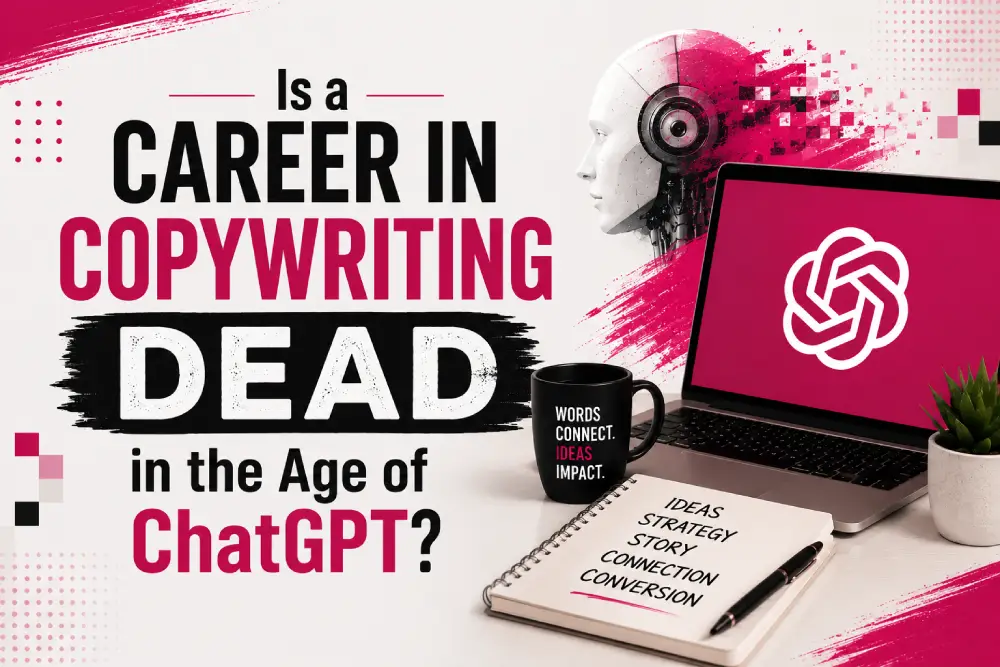
The growing interest in a career in copywriting coincides, notably, with rising anxiety about artificial intelligence and its implications for creative labour. The rising anxiety about AI replacing creative labour says something important about where your head is right now.
In an era where ChatGPT writes taglines and Gemini drafts email subject lines, the debate regarding the future of human copywriters is gaining major prominence. If you are a Class 12 student, an undergraduate, or a creative professional rethinking your path, the fear is legitimate.
But here is what the data, the agencies, and the people actually hiring in India in 2025 and 2026 are saying: the career in copywriting is not dead. It has changed. Significantly. And that change creates more opportunity for trained, thinking writers, not less.
This blog gives you the honest picture.
What Does a Career in Copywriting Actually Require?
Before getting into the AI debate, it is worth being precise about the craft.
Copywriting is the strategic use of language to move people. It is the headline on a Zomato notification that makes you tap at 11 PM. It is the Swiggy subject line you open even when you swore you were on a diet. It is the product description that makes a premium price feel reasonable. It is the three-word tagline that stays with a brand for a decade.
A copywriter is not just someone who writes. A copywriter understands consumer psychology, brand voice, cultural context, media platform behaviour, and the tension between what a brand wants to say and what an audience actually needs to hear.
That combination of creative instinct and strategic thinking is not something a language model generates. It is something a trained human builds.
So, What Can ChatGPT Actually Do?
AI tools like ChatGPT are efficient at producing high-volume, templated content, product descriptions, email variations, SEO filler, and basic social posts. They are poor at original creative strategy, cultural nuance, campaign thinking, and work that requires genuine brand understanding. Professional copywriting careers operate at a level AI tools currently cannot reach.
To be fair to the technology, AI tools are genuinely useful for parts of the writing process. They can brainstorm quickly, produce first drafts at scale, suggest variations, and assist with tasks like writing meta descriptions or structuring blog outlines.
Agencies are using these tools. In-house content teams are using these tools. That is real.
But here is the distinction that matters for your career: AI tools are used by professional copywriters. They are assistants, not replacements. The person deciding what the brief is, what the strategy requires, what the cultural insight is, and what angle will actually make an audience feel something, that person is still human.
Every major agency operating in India today, from Ogilvy and McCann to the mid-size independents in the major cities of India, is looking for writers who can think strategically and execute creatively. The demand for junior copywriters with strong portfolios and conceptual ability has not collapsed. If anything, the bar has shifted: they want writers who understand AI tools and can produce work the tools cannot.
The Real Copywriting Career Opportunities in India Right Now
India’s advertising and brand communication industry employs hundreds of thousands of professionals. According to LinkedIn’s 2025 report, over the year, digital marketing roles have increased by 18%, which implies that over 2 million professionals are now employed in digital marketing roles across the country. Mumbai remains the creative capital, with Bangalore growing rapidly as a hub for tech-adjacent brand, content, and digital marketing roles.
Here is where trained copywriters work today:
Advertising Agencies: JWT (now VML), Ogilvy, McCann, Leo Burnett, BBDO, Dentsu, Publicis, and dozens of Indian-origin agencies and boutique shops. Junior to mid-level copywriting roles remain among the most sought-after positions for creative graduates.
In-House Brand Teams: E-commerce platforms, fintech companies, consumer brands, and startups all employ writers for product copy, UX writing, and brand content. Roles here often pay well and offer significant creative ownership.
Digital and Content Studios: Performance marketing agencies, content production studios, and social media-first agencies are among the fastest-growing employers of copywriters in India today.
Independent and Freelance Practice: India’s freelance economy for creative professionals has matured considerably. A strong portfolio now enables copywriters to work directly with brands, build retainer relationships, and set their own terms.
Media and Publishing Platforms: OTT platforms, digital media houses, branded content teams, and podcast studios are growing markets for writers who understand both storytelling and audience behaviour.
The variety of copywriting career opportunities in India is, in 2025 and 2026, wider than it has ever been. The question is whether you enter these markets with a portfolio and conceptual ability, or without one.
Copywriter vs AI: What Humans Still Do Better
This is the comparison table that matters if you are evaluating whether to pursue this career.
The Creative Skills Comparison: Human Copywriter vs AI Tools
| Task | AI Tool | Human Copywriter |
| Generating 50 subject line variations quickly | Strong | Slower |
| Understanding a brand’s cultural positioning | Weak | Strong |
| Conceptual campaign thinking (the “big idea”) | Weak | Strong |
| Consumer psychology and behavioural insight | Limited | Core skill |
| Adapting tone for different audiences or media | Inconsistent | Core skill |
| Producing original, award-winning creative work | Cannot | Can |
| Working with a brief, client, and strategy team | Cannot | Core role |
| Understanding humour, irony, and cultural timing | Poor | Strong |
| Building a brand voice over time | Cannot | Core skill |
| Writing for UX flows and interaction design | Limited | Growing skill |
| Integrating AI tools into a professional workflow | N/A | Expected skill |
The honest picture: AI handles volume and repetition. Human copywriters handle judgment, strategy, and originality. The professionals who will thrive in this industry are those who use AI as a tool while building the skills AI cannot replicate.
What Agencies Are Actually Hiring For
It is worth going beyond the think-pieces and looking at what the hiring landscape actually reflects.
Creative directors at leading Indian agencies consistently report that the scarcity is not in the number of applicants, but in the quality of portfolios and the ability to think at a campaign level. They want writers who understand brand strategy, who can pitch an idea in a room, who can write across formats (film, digital, social, print), and who have the curiosity to understand what motivates people.
These are not things a course that teaches copywriting tips produces. They require a structured creative education, one that involves live briefs, industry mentorship, portfolio development, and sustained exposure to how real agencies think.
This is precisely the gap that portfolio-first, industry-led creative education programs are designed to address. Programs built around real client projects, advertising agency standards, and the kind of conceptual training that makes a graduate genuinely hirable, not just technically credentialed.
How NoMAD Approaches Creative Writing Education
NoMAD College of Creative Intelligence, with campuses in Mumbai and Bangalore, structures its learning around exactly the skills the industry is hiring for.
The Bachelor’s Program in Advertising and Communication Design (Mumbai University-backed, four years) includes dedicated tracks in creative writing, copywriting, script writing, and wordsmithing, taught not as theory modules but as practice-led disciplines. Students work on live briefs, develop their individual creative voice, and build a portfolio through actual projects rather than classroom exercises.
The Post Graduate Program, Diploma in Advertising and Media, developed with Miami Ad School India, places writing for brands as one of its four core verticals. Students work under industry practitioners, graduate with a globally relevant portfolio, and access the global network that Miami Ad School’s 16 international campuses represent.
NoMAD’s AI-first learning environment ensures that students understand and work with current AI tools as part of their professional preparation, not to replace creative thinking, but to support and accelerate it.
What the Future of a Copywriting Career Looks Like
The writers who will define the next decade of advertising and brand communication in India are not going to be those who avoided AI, or those who surrendered the craft to it. They are going to be the writers who developed strong conceptual and strategic foundations, understood how to use every tool available, and built bodies of work that demonstrate genuine creative intelligence.
The future of the copywriting career in India looks like: more platforms, more formats, more demand for writers who can navigate between long-form brand storytelling and six-second digital content. It looks like UX writing, brand voice strategy, AI-assisted content at scale, and, for the strongest, the kind of campaign-level thinking that wins awards, builds reputations, and justifies premium fees.
None of that is threatened by ChatGPT. All of it requires the kind of training that helps you think before you write.
Conclusion
The fear that a career in copywriting is dying is understandable. The reality is different.
What is dying is the value of mediocre, templated, undifferentiated writing, and that was always going to happen eventually, with or without AI. What is growing is the demand for writers who can think, who understand brands and people, who can produce original work that moves audiences.
If you have a genuine interest in language, ideas, communication, and the creative industry, the opportunity in front of you is real. The question is how you build the skills and the portfolio that earn you a place in it.
If you are serious about turning that interest into a creative career, explore what NoMAD College of Creative Intelligence offers. Visit nomadcollege.in/programs to understand the program, or reach out to the admissions team at nomadcollege.in/admissions to learn more about applying.
Frequently Asked Questions
1. Is a career in copywriting still viable in India in 2025 and 2026?
Yes. The demand for trained copywriters across advertising agencies, brand teams, digital studios, and independent practices remains strong in India. The skill set required has evolved; writers are now expected to understand strategy, AI tools, and multi-platform content, but the career path is active and growing.
2. Will AI replace copywriters?
AI tools are being used extensively for templated, high-volume content tasks. However, they cannot replace the conceptual thinking, cultural understanding, brand strategy, and original creative work that professional copywriters produce. Most agencies now expect copywriters to use AI tools as part of their workflow, not instead of developing their own craft.
3. What does a copywriter do in an advertising agency?
A copywriter in an advertising agency develops the language and ideas that drive campaigns, from headlines and taglines to scripts, social content, and brand messaging. They work alongside art directors and strategists, respond to client briefs, and are responsible for the creative expression of a brand’s communication strategy.
4. How do I start a career in copywriting after Class 12?
The most direct path is through a structured creative education program, one built around portfolio development, live briefs, and industry mentorship rather than pure theory. Programs in advertising, communication design, and creative media at institutions with industry connections provide the foundation that makes graduates genuinely hirable.
5. What skills do I need for a copywriting career?
Strong writing craft, conceptual thinking, consumer psychology awareness, brand voice understanding, comfort with multiple formats (digital, print, script, social), and the ability to work within a strategy brief. Knowledge of AI writing tools and how to use them professionally is increasingly expected.
6. What is the scope of copywriting career opportunities in India?
The scope spans advertising agencies, in-house brand teams, e-commerce and fintech companies, digital marketing agencies, content studios, OTT and media platforms, and independent freelance practices. Mumbai and Bangalore are the primary hiring markets, though remote and hybrid roles have expanded the geography significantly.
7. Is a copywriting course or degree necessary to become a copywriter?
Formal education is not the only path, but it significantly accelerates career readiness. A portfolio-first program that involves real briefs, agency-level mentorship, and structured feedback compresses years of learning into a structured period and provides both the portfolio and the industry connections that self-study alone rarely builds.
Related Posts